Insight · AI strategy & architecture
The next use case is the real test of your AI platform.
Build a foundation that makes the next useful application easier to deliver, with a clear architecture, staged investment and a senior team that can operate it.

At a glance.
Build shared capabilities where repeated business needs justify owning them.
Release funding against working use cases and the cost of running them.
Put senior internal engineers in charge of building and operating the foundation together.
First, what are we building?
An enterprise AI platform is a shared set of software services that lets people use AI with the company’s information and systems. The workspace is the front door; behind it sit the connections, permissions, models and operating tools that make useful applications possible. A company can buy much of this foundation and build the parts its work requires.
Key terms in plain English
- reference architecture
- A reusable map of the capabilities and boundaries a solution needs. It guides a company’s design; it is not a vendor shopping list or a finished deployment plan.
- orchestration
- The coordinator that decides which steps run, in what order and when a person must approve the next action.
- model gateway
- A common access point for AI models that can route requests and apply usage controls. The team still tests each model for the job it will do.
- API
- A defined way for one piece of software to request information or an action from another, such as checking an order’s status.
- MCP
- Model Context Protocol gives AI applications a standard way to discover tools and exchange context. It does not itself grant permission to use a company’s systems.
- retrieval-augmented generation
- Finding relevant, permitted information and giving it to a model with the question, like opening the right reference book before answering.
- read replica
- A maintained copy of selected records used for reading or analysis. It may lag behind the original system, so freshness and access rules matter.
- trust boundary
- A dividing line between environments or users with different permissions. Crossing it requires explicit checks; being inside one area does not open every other door.
- evaluation
- A repeatable test of whether an AI application completes representative tasks to the required quality, safety, time and cost standard.
- DevOps
- A way of working in which engineers build, release and run software together, using feedback from live operation to improve it.
- runtime
- The computing environment that actually runs an application, including processing, storage, networking and the services it depends on.
- tokens
- The small units into which a model divides input and output. They help measure model consumption, but do not capture every cost of running an application.
- multi-agent architecture
- Several AI-driven workers divide a task between them. This can help specialist or parallel work, but adds coordination, cost and failure points.
Hover, focus or tap a dotted-underlined term for a short explanation.
An AI platform becomes an expensive distraction when user numbers and features keep growing, but little changes in how people actually work. A polished interface and several thousand activated accounts can conceal a remarkably thin investment case.
The real test arrives with the next use case. Does a new team inherit working connections, tested controls and a reliable release path? Or does it start again with another supplier, another data extract and another permission negotiation? A platform earns its investment when useful applications become easier to deliver and dependable to operate.
At Scipio & Partners, we have helped businesses worldwide make these choices, from architecture and investment priorities to finding the right people and establishing delivery through build, operate and transfer. The recurring lesson is that technical design, leadership and funding cannot be separated. A sound architecture without an empowered delivery team becomes a diagram. An energetic team without a coherent foundation builds the same connections repeatedly.
I would make the decision in this order: establish where needs repeat, choose which capabilities to own, fund the smallest useful foundation and give a senior internal team the authority to operate it. The reference architecture below makes those choices tangible. Its purpose is to connect an investment decision to something a delivery team can build.
1. Organisational scale strengthens the case when business needs repeat.
For a non-technology-native organisation with more than 10,000 employees, I would put a shared AI foundation firmly on the board agenda. At that scale, repeated knowledge work, fragmented systems and different local solutions can make common services particularly valuable. The employee count is a useful screening signal, not a technical threshold or a guarantee of return.
A smaller engineering-intensive business may need substantial integration. A much larger business may initially get more value from configuring existing enterprise AI products well. Count the people doing suitable tasks, the frequency of those tasks and the systems involved. Total headcount is a poor substitute for that analysis.
The investment case becomes stronger when several valuable workflows need the same identity controls, data connections, evaluation tools or operating support. A service team, a commercial team and a finance team may each need reliable access to product and customer information. Building that access once can be useful. Funding three teams to recreate it is expensive.
Start with a short list of named workflows and accountable business owners. Establish today's cycle time, error rate, manual effort and service outcome. Then ask what existing software already provides. If the remaining need is mainly drafting, summarising and general research, a purchased enterprise assistant may be sufficient. A proprietary portal has to offer more than your logo on a chat box.
2. Six layers turn a platform ambition into a buildable foundation.
The A reusable map of the capabilities and boundaries a solution needs. It guides a company’s design; it is not a vendor shopping list or a finished deployment plan. separates business applications from the reusable capabilities beneath them. It is industry agnostic: a service response, a finance reconciliation and a maintenance assistant can use the same model access, identity checks and release tools while retaining their own business rules. These are logical responsibilities. Several may be delivered by one purchased product or by existing enterprise services.
Read the diagram from the business experience down to its foundations. The controls on the right apply across every layer. The stack is a capability map, not a claim that every request travels through six sequential steps. Core systems remain the authoritative source for business transactions; the platform connects to them through approved interfaces.
Exhibit 01
A reusable AI foundation separates business applications from models, data and runtime.
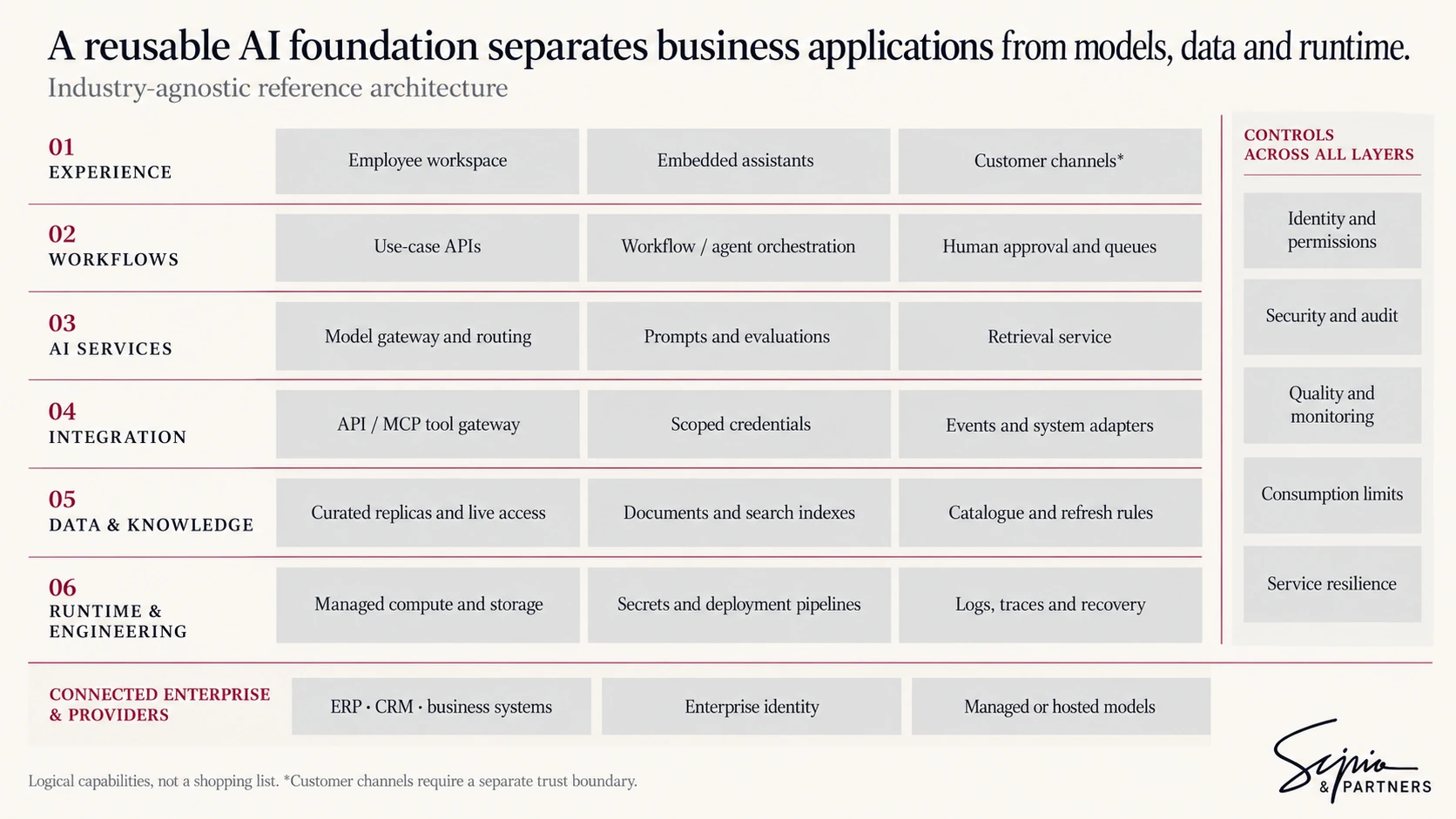
Reuse existing services where they fit, and add capabilities as the work requires them. Customer channels need a separate trust boundary.
Read the framework
- 01 · Experience
- Employee workspaces, assistants embedded in existing tools and customer channels are entry points. A structured task may need a form rather than chat. Customer channels require separate access boundaries and tested isolation from employee information.
- 02 · Workflows
- Use-case APIs expose the application’s functions. Workflow or agent orchestration coordinates steps. Human approval gates consequential actions, while queues hold longer-running work and make retries manageable.
- 03 · AI services
- A model gateway routes requests to suitable models. Versioned prompts and evaluations make changes testable. Retrieval services assemble relevant, authorised context. Managed products can supply these capabilities; they need not be custom-built.
- 04 · Integration
- An API/MCP tool gateway exposes permitted actions. Scoped credentials restrict what each connection can do. Events signal business changes; system adapters translate requests into a core system’s interface. Controls remain enforceable outside the model.
- 05 · Data and knowledge
- Curated replicas support appropriate read workloads; live access serves tasks requiring current state. Documents and search indexes supply knowledge. A catalogue identifies owners and meaning, while refresh rules define freshness, deletion and permission updates.
- 06 · Runtime and engineering
- Managed compute and storage run the services. Protected secrets and deployment pipelines make changes repeatable. Logs, traces and recovery procedures reveal failures and support restoration. Reuse the company’s engineering foundations wherever they meet the need.
- Controls across all layers
- Identity and permissions, security and audit, quality and monitoring, consumption limits, and service resilience span the entire architecture. Shared services do not mean unrestricted access or one undifferentiated budget.
- Connected enterprise and providers
- ERP, CRM and other business systems remain authoritative systems of record. Enterprise identity supplies verified user context. Managed or hosted models provide inference. The drawing groups responsibilities rather than prescribing a network topology or serial request path.
The first important separation is between a workflow and the model it calls. The coordinator that decides which steps run, in what order and when a person must approve the next action. determines the approved sequence of work; the model supplies a prediction, interpretation or draft within that sequence. A A common access point for AI models that can route requests and apply usage controls. The team still tests each model for the job it will do. can centralise routing and consumption controls. The team should be able to change a model without rewriting every business application, while still retesting its behaviour.
The second separation is between asking for information and changing a business record. An A defined way for one piece of software to request information or an action from another, such as checking an order’s status. is an agreed way for systems to communicate. Model Context Protocol, or Model Context Protocol gives AI applications a standard way to discover tools and exchange context. It does not itself grant permission to use a company’s systems., standardises how AI applications discover tools and exchange context. Neither is a reason to give an application broad access. Expose narrow operations, such as checking an order or preparing a draft adjustment, with permission and validation checks at the tool boundary.
Source documents: MCP architecture and scope.
The architecture does not require you to train a large language model or replace the company’s data estate. It requires the team to specify interfaces, access boundaries and operating responsibilities. Before approving implementation, ask for a deployment view showing where services run, which data may cross each boundary, what is reused and how the system is recovered. That is how this reference becomes a design for your company.
3. The right architecture combines purchased capabilities with selective ownership.
There are three broad choices, and a company can use all three for different needs. Buying and configuring an enterprise assistant is often the fastest route to common productivity tasks. Building a shared integration layer becomes attractive when valuable workflows cross systems or require a distinctive experience. Operating selected models yourself adds control over deployment but also adds engineering, capacity planning and maintenance.
For a non-technology-native company, my starting preference is managed infrastructure with a deliberately small amount of custom software. Reuse identity, monitoring and deployment capabilities that already work. Build the connections and workflow behaviour that matter to the business. Avoid recreating commodity services merely to call the result independent.
Exhibit 02
Business requirements determine which platform layers the company should own.
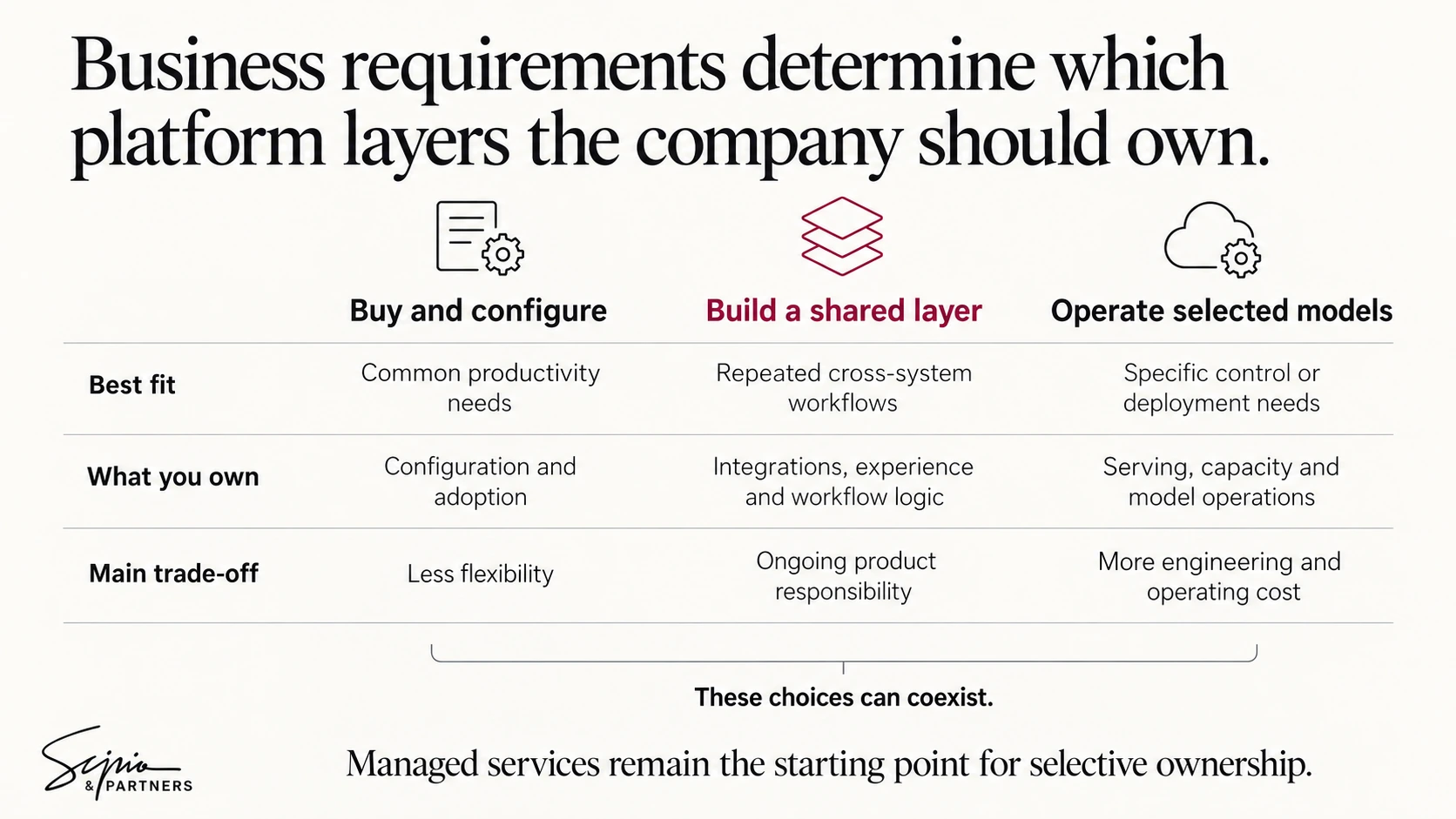
Purchased tools, a shared integration layer and selected model hosting can coexist in one architecture.
Read the framework
- Buy and configure
- Best fit: common productivity needs. The company owns configuration and adoption. The principal trade-off is less flexibility over the product's behaviour and roadmap.
- Build a shared layer
- Best fit: repeated workflows across systems. The company owns integrations, experience and workflow logic. The trade-off is ongoing product responsibility.
- Operate selected models
- Best fit: specific control or deployment requirements. The company owns serving, capacity and model operations. The trade-off is additional engineering and operating cost.
- Combine the choices
- These choices can coexist. Start with managed services and add ownership where business evidence supports it, rather than treating more custom infrastructure as a sign of maturity.
Low-code tools can be excellent for bounded workflows. Custom development is useful where user experience, integration or operating requirements exceed those tools. Require the delivery team to explain the choice in terms of the task and its lifetime cost. A preference for one tool should not determine the company's architecture.
For model choice, compare quality on your tasks, response time, usage cost, deployment options and contractual treatment of data. Keep a route to change providers, but recognise that switching models requires renewed evaluation: prompts, tool behaviour and output quality can change. Self-hosting an open model can address a particular constraint; it is not automatically cheaper or safer.
Choose the The computing environment that actually runs an application, including processing, storage, networking and the services it depends on. to fit the workload. Managed functions or application services can suit short, intermittent tasks with little infrastructure administration. Containers can suit longer-running workers, custom dependencies or greater runtime control. A managed container service may be enough; running a cluster yourself adds operational responsibility. Select regional deployments where latency, resilience or applicable data requirements justify them, rather than building a global estate on day one.
A multi-cloud or multi-model design should solve a specific problem such as resilience, geographic requirements or quality differences. Every additional provider adds operational work. The board should see which dependency is being reduced and what the extra complexity costs.
4. Useful data access and controlled actions determine how far the platform can grow.
A model does not know which version of your pricing policy is approved or which order has just changed. The data layer supplies that context. Start with the information needed for the first workflows, with named owners and clear definitions, rather than copying everything into a new repository.
For documents, Finding relevant, permitted information and giving it to a model with the question, like opening the right reference book before answering., or RAG, means finding relevant passages and giving them to the model with the question. It is closer to opening the right reference book than teaching the model your whole business. The answer still needs to be evaluated, and retrieval must exclude information the user is not authorised to see.
For core-system records, a governed A maintained copy of selected records used for reading or analysis. It may lag behind the original system, so freshness and access rules matter. or curated data product can serve frequent analysis without placing the same query load on operational systems. A replica is a controlled copy, not a new source of truth. Define what is copied, how fresh it must be, how permissions and deletions propagate, and how errors are detected. Use a live API where the task requires current state. A stock decision cannot silently rely on yesterday's availability.
Carry the user's authorisation context through retrieval and tool access. Logging into the front door does not entitle someone to every record behind it. Customer-facing applications require a deliberately separate A dividing line between environments or users with different permissions. Crossing it requires explicit checks; being inside one area does not open every other door., curated data and tested isolation; do not expose the employee environment simply by changing its interface.
Source documents: Microsoft guidance on identity and authorised retrieval.
Each expansion should add a capability the next workload actually needs.
Start with one useful, bounded application
Use an existing employee channel, managed model access, enterprise identity and one governed information source. Include evaluations, logs, consumption limits and a repeatable deployment path from the start. Prove the task before building a broad portal.
Connect workflows that need current information or action
Add scoped system APIs, a tool catalogue and approval rules. Introduce queues, timeouts and duplicate-action protection where tasks run asynchronously or change records. Use replicas for suitable read workloads and live APIs where freshness is essential.
Enable several teams to reuse the foundation
Offer documented interfaces, application templates, automated checks and per-workload cost visibility. Add capacity and regional instances as demand and service commitments require them. Domain teams own business behaviour; the platform team keeps shared services dependable.
Extend selected capabilities to customer products
Create a separate customer access boundary, approved data products, support commitments and tested isolation. Reuse engineering components without exposing the employee environment. Add specialist agents or hosted models only when the task and economics justify them.
Several AI-driven workers divide a task between them. This can help specialist or parallel work, but adds coordination, cost and failure points. becomes useful when a task benefits from distinct specialist work or parallel investigation. It also creates more hand-offs, model calls and opportunities for errors. Compare it with a simpler workflow on the same A repeatable test of whether an AI application completes representative tasks to the required quality, safety, time and cost standard. set before committing. More agents are not evidence of a better platform.
Source documents: Anthropic guidance on choosing workflows and agents.
5. Funding should follow evidence while covering the full cost of operation.
Do not set the budget as a fashionable percentage of revenue or multiply all employees by an assumed productivity gain. Price the next useful capability. Include the delivery team, integration, security and quality assurance, licences and consumption, adoption, support and eventual retirement. Existing employees have an economic cost even where no additional cash leaves the company.
Separate the cost of the common foundation from the cost of each use case. Otherwise the platform can appear cheap because business units pay for integration, while the business units appear inefficient because they carry infrastructure used by everyone. Show both the full enterprise cost and the incremental cost of adding another workflow.
Exhibit 03
Evidence of usefulness, reuse and reliable operation earns the next funding tranche.
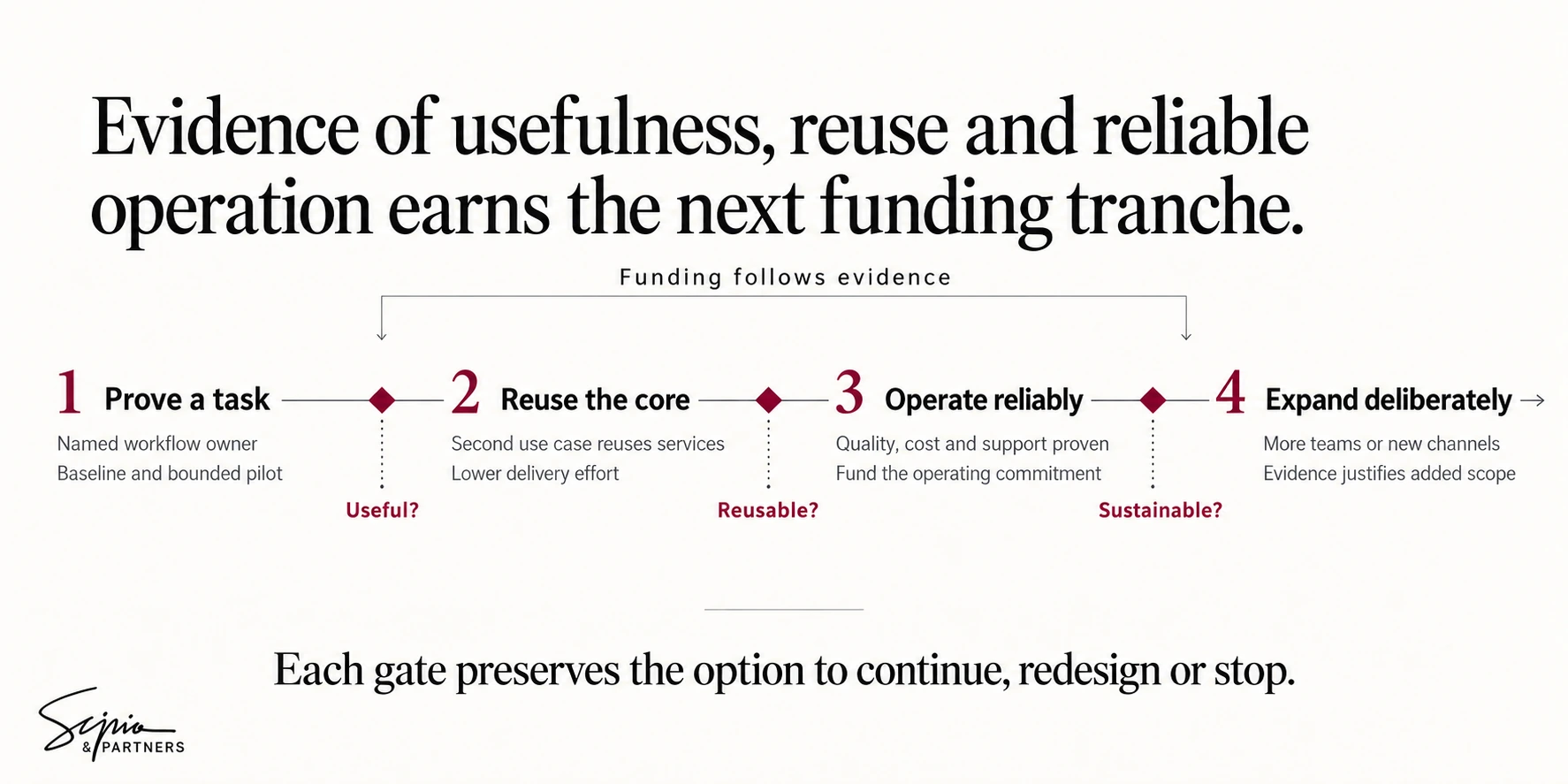
Each review releases a defined increment of scope and preserves the option to redesign or stop.
Read the framework
- Prove a task
- Name the workflow owner, establish a baseline and run a bounded pilot. Ask whether the result is useful before extending scope.
- Reuse the core
- Have a second use case reuse services and test whether delivery effort falls. Reuse must be demonstrated, not merely promised in an architecture diagram.
- Operate reliably
- Prove quality, cost and support arrangements, then fund the operating commitment. Ask whether the service is sustainable before broad expansion.
- Expand deliberately
- Add teams or channels where evidence justifies the additional scope. Funding follows evidence; there is no universal timetable for moving through these stages.
- Decision at every gate
- Continue, redesign or stop. Protect a viable team and its operating responsibilities while making further expansion conditional on evidence.
Evaluate benefits with the same discipline. Hours released create capacity; they become financial savings only when spending is avoided or the operating model changes. Faster service can create value, but revenue claims need an attributable commercial mechanism and should be assessed at contribution margin. Do not count the same benefit again as both productivity and headcount savings.
Test the case under lower adoption, higher review effort and higher consumption. Include the cost of failures and support. Compare the platform with buying and configuring existing tools, and with a smaller integration scope. Fund enough to establish proof, but do not commit to an enterprise-wide rollout before the next decision can be made on evidence.
6. Two senior engineers create a stronger foundation than one celebrated platform lead.
IT, digital and innovation can each provide a sensible organisational home. What matters is a direct route to C-level decisions and the practical ability to obtain access, prioritise, release and operate software. Innovation without a production route becomes a demonstration unit. IT without a delivery mandate can turn every experiment into a waiting list.
My starting recommendation is a small internal AI platform A way of working in which engineers build, release and run software together, using feedback from live operation to improve it. team anchored by at least two experienced engineers working as peers. One might bring deeper platform and integration expertise, the other stronger application and AI delivery experience. Both should understand the architecture, review each other’s changes and be able to operate the critical services. Two is a starting point for shared ownership, not a claim that two people can provide every skill or round-the-clock global support.
Hire people who have shipped and operated software, can diagnose failures and can explain their technical trade-offs. Pay for that judgement. Familiarity with low-code products alone does not establish it, and a large junior team is not a substitute for it. In a global business, share regional engagement and operational responsibilities deliberately, with overlap for review and handover. Fund additional cover when availability commitments require it.
The team reports directly to a C-level sponsor against one prioritised roadmap. Name a responsible engineer and a reviewing peer for each service, and a business owner for the outcome. Set delegated budget and release authority within agreed boundaries. The sponsor settles cross-business priorities and removes blockers; engineers make technical decisions within that mandate. Shared ownership needs explicit responsibilities, without manufacturing a new management hierarchy.
Exhibit 04
A senior internal DevOps team keeps delivery fast and ownership shared.
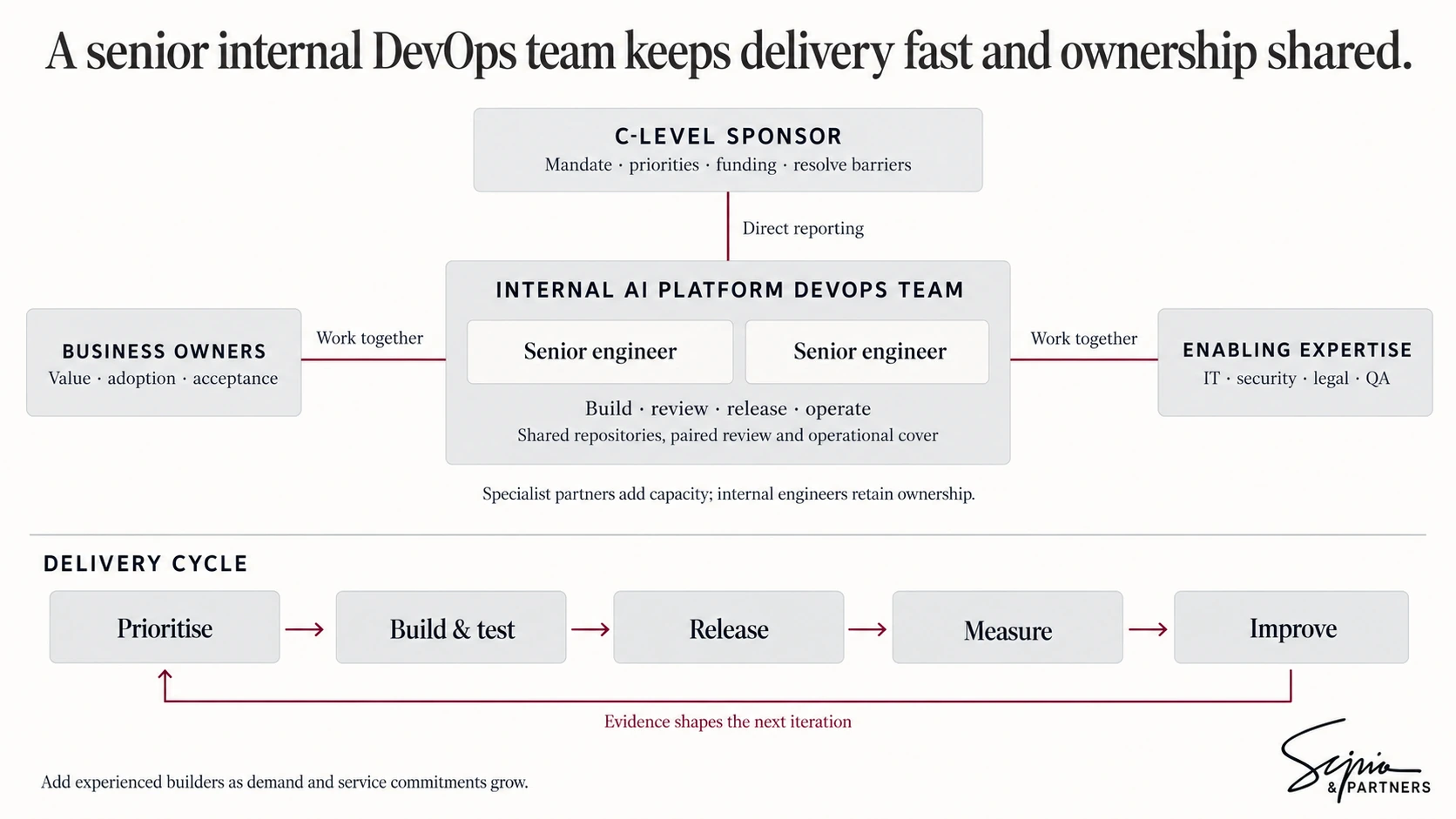
Reporting lines connect the team to decisions; the delivery loop connects working software to the next priority.
Read the framework
- C-level sponsor
- Give the team its mandate, priorities and funding, and resolve barriers. The vertical line represents direct reporting, not a software hand-off.
- Internal AI platform DevOps team
- Two senior engineers form an initial peer core, sharing build, review, release and operation. Shared repositories, paired reviews and operating cover reduce dependency on one person. Add experienced builders as demand and service commitments grow.
- Business owners and enabling expertise
- Business owners define value, adoption and acceptance. IT, security, legal and QA provide enabling expertise. Plain horizontal lines represent collaboration, not organisational reporting or process sequence.
- Specialist partners
- Partners add targeted capacity or independent assurance; internal engineers retain the architecture, repository access and operating knowledge.
- Delivery cycle
- Prioritise, then build and test, release, measure and improve. Each arrow advances one step. A single return arrow carries evidence from improve back to prioritise. The cycle has no arrows into the organisational boxes above it.
Use specialist partners for a difficult integration, additional builders or independent quality assurance. Keep source code, deployment accounts, architectural decisions and operational knowledge accessible to the internal team from the first day. Build, operate and transfer should develop internal capability while delivery happens; it should not leave the company buying back its own knowledge at handover.
Assess performance through working releases, reliability, sound prioritisation and the ability to remove delivery constraints. When progress stalls, distinguish a capability problem from missing access, unclear priorities or inadequate resources. Fix the constraint, set explicit delivery expectations and replace persistent underperformance where those conditions are in place. A senior title does not excuse an absence of delivery.
For the CEO, challenge both unqualified enthusiasm and blanket refusal. Ask the CIO which specific risk prevents a proposed release, what bounded alternative would address it, and who will make the decision by when. Involve legal and security early enough to design that route together. The objective is usable authority within clear limits, with a team capable of exercising it.
7. Bounded releases and enforced consumption limits create room to experiment.
Give builders usable development environments, approved access and a route to production. Separate development, testing and live operation. Start sensitive workflows with read-only access or draft outputs, and introduce write actions through narrowly scoped tools with validation and appropriate human approval. The ability to read an order should not automatically include the ability to change it.
Test realistic tasks, permission boundaries, malicious instructions hidden in retrieved material, incorrect tool use and failure recovery. A model's answer is not an authorisation decision. Keep permissions and consequential-action checks in enforceable application controls. MCP standardises connections; it does not make every connected tool trustworthy.
Source documents: MCP security guidance.
Release first to a bounded group, observe quality and failures, and expand only against agreed criteria. Maintain a way to disable a tool or roll back a release. Give every application an owner, a support route and a retirement decision. A growing collection of unowned micro-apps will eventually become the next application-portfolio problem.
Set model and usage limits by workload, team or user, rather than giving every task unlimited access to the most expensive model. The small units into which a model divides input and output. They help measure model consumption, but do not capture every cost of running an application. are units of model input and output, and a useful consumption measure. Also monitor tool calls, runtime, storage and paid external services: a token cap alone cannot cap the whole bill.
Combine alerts with enforced quotas, maximum output sizes, timeouts, retry limits and limits on an agent's steps. Define what happens when a cap is reached: stop, queue work or use an approved fallback, with a controlled exception process for critical services. Budget alerts alone do not prevent spending, and delayed provider metering can leave exposure before a limit takes effect. Test enforcement and allow headroom.
Source documents: Microsoft AI gateway quotas and monitoring.
Evaluate quality and cost together. A cheaper model that creates substantial rework can cost more per accepted result. Monitor the cost of a successfully completed task, including review effort, rather than celebrating cheap calls or high activity. Protect sensitive information in logs as carefully as in the application itself.
8. The board should see working use cases, delivery constraints and realised value.
Personal productivity should make useful AI available across the organisation. Onboarding matters, but it is the beginning of adoption. If the monthly report celebrates activated accounts while nobody can identify recurring tasks that improve, the investment is losing direction.
Use a live view of the portfolio that connects each workflow to its owner, stage, next release, current constraint and business measure. Require evidence from real use. A platform team should be able to explain what went live, who uses it repeatedly, what failed and what changed as a result.
Six questions keep the board focused on distinct dimensions of progress.
- Value — Which live workflows improve a named business outcome against its baseline? A rising account count without recurring useful work is the warning sign.
- Delivery — How quickly do agreed priorities reach controlled release, and where does work wait? Persistent ideation, growing queues and repeatedly missed releases require intervention.
- Architecture — What does the next use case reuse, and how much effort does that save? Rebuilt connectors, duplicated controls and one-off integrations expose a weak foundation.
- Operational assurance — Does the service meet its quality, access and reliability standards, and can the team recover it? Unresolved permission failures, unchecked outputs or untested recovery are warning signs.
- Economics — What is the full cost per successful task, and which workloads earn further funding? Unenforced spending limits and benefits without a credible financial mechanism undermine the case.
- Capability — Can the internal team prioritise, change and operate the platform with dependable cover? Reliance on one individual or an external partner for every release signals a capability gap.
Scipio & Partners helps executive teams choose the architecture, size the investment and appoint the people required to deliver. We have established these capabilities for clients globally through build, operate and transfer: build the foundation around valuable workflows, operate it with the client until delivery and support are dependable, and transfer the capability with clear ownership.
Transfer should be designed at the start. Agree ownership of code and accounts, internal counterparts, operational documentation and acceptance criteria. The receiving team should demonstrate that it can release, monitor and recover the service. A handover presentation alone does not establish that capability.
The board's next decision should be specific: which work to improve, which shared components it needs, who is accountable and what evidence releases the next investment. A platform deserves to grow when it makes the business more capable and the next useful application easier to deliver.