Insight · Private equity & AI
AI products in private equity: back the builders.
How PE leaders can judge AI teams, remove delivery barriers and turn working software into portfolio value.

At a glance.
Back leaders who can build, judge architecture and take responsibility for a live product.
Give a small delivery team the authority, infrastructure and parallel support to move quickly.
Review working releases, adoption and economics through a live portfolio dashboard.
An AI team should earn a managing director’s confidence through software people use, the speed of improvement and evidence that the economics work. An expanding hierarchy of AI vice presidents, programme leads and portfolio coordinators proves none of these. When management capacity grows faster than working products, the fund should challenge the setup before funding more of it.
In my experience, the stronger starting point is a small team led by someone who has built and operated software: a person who can inspect code, judge architecture, understand a production failure and help resolve it. Give that person capable builders, clear commercial priorities and the resources to release. Additional management should solve an observed delivery problem, rather than arrive ahead of one.
For a PE managing director, this is a capital-allocation discipline. The questions are concrete: what is live, who uses it, what changed, what did it cost and what is preventing the next release? Those questions apply to customer-facing AI products and to the smaller applications that improve everyday work across portfolio companies.
1. Trust delivery evidence. Challenge the theatre.
Ask to see the product in use. Then ask what the team itself built, when the last meaningful change reached users and what it learned from their behaviour. A credible lead can show a release history, explain a failure and identify the next constraint. The answer should survive a conversation with an engineer and a user, without requiring a newly prepared presentation.
Persistent ideation, repeated demonstrations with no route into operation and a roadmap that advances mainly through new job titles are warning signs. So is a leader who cannot explain a technical decision without calling an external supplier. A difficult integration can justify delay; an inability to diagnose it or offer a smaller release is a different problem. Ask for the specific dependency, its owner and the decision required.
Make the first commitment small enough to test. Identify one user, one recurring task, a baseline and acceptance conditions. A working front end can quickly expose a poor workflow or weak demand. Label it as a prototype. A proof of value needs evidence that the intended task improves; a pilot tests that evidence with real users; production adds reliable operation and support. Do not report all four as delivered business value.
We organise AI opportunity discovery across three value pools: the core commercial engine, productivity in the support organisation, and AI products that customers pay for. This gives a fund a practical way to uncover use cases against each company’s investment thesis. The first improves how the existing business acquires, serves and retains customers. The second improves the work around that value chain. The third creates a monetisable offer.
Exhibit 01
Three value pools. One delivery foundation.
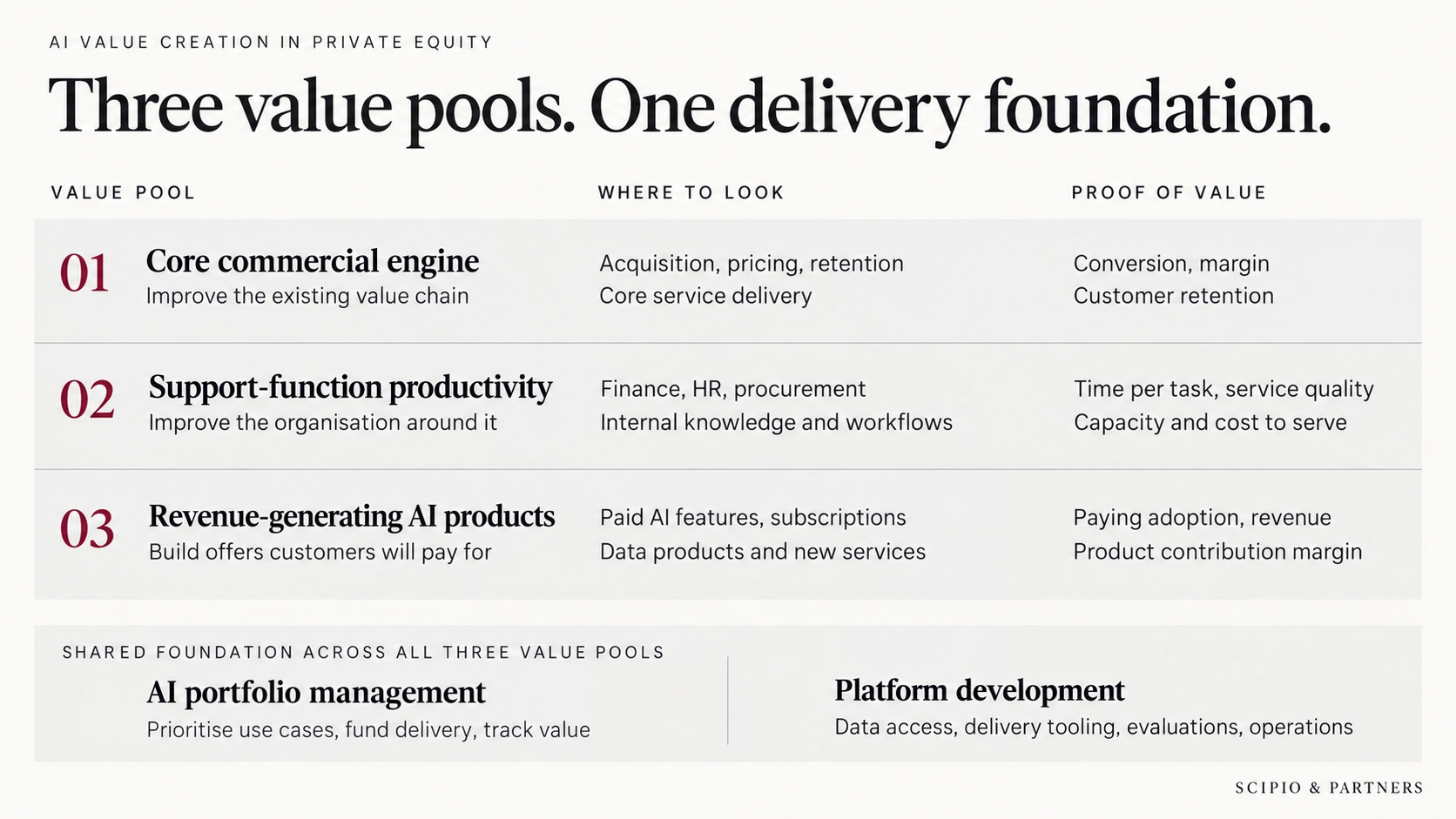
Uncover use cases across three value pools, supported by portfolio management and platform development.
Read the framework
- 01 — Core commercial engine
- Improve the existing value chain. Look at acquisition, pricing, retention and core service delivery. Measure conversion, margin and customer retention against the current baseline.
- 02 — Support-function productivity
- Improve the organisation around the value chain: finance, HR, procurement, internal knowledge and workflows. Measure time per task, service quality, capacity and cost to serve. Released time becomes a cash saving when the cost base changes.
- 03 — Revenue-generating AI products
- Build offers customers will pay for: paid AI features, subscriptions, data products and new services. Measure paying adoption, revenue and product contribution margin, including delivery and support costs.
- Shared foundation — AI portfolio management
- Prioritise use cases, fund delivery and track value across all three pools. Give each initiative a business owner, baseline, release milestone and next investment decision. Use the delivery dashboard to direct capital and remove constraints.
- Shared foundation — Platform development
- Provide data access, delivery tooling, evaluations and operations across all three pools. Reuse what helps builders ship and maintain products; expand the platform in response to delivery demand.
Treat portfolio management and platform development as a shared investment supporting all three pools. Keep their costs visible and tie expansion to releases they enable. Each use case needs one primary value pool and one accountable business owner. An AI sales assistant may improve conversion in the existing commercial engine; an AI research subscription belongs in the product revenue pool. Where benefits overlap, count the same revenue or saving once. Rank opportunities by credible value, time to a useful release and the effort required to operate them, then use delivery evidence to decide the next investment.
2. Put a builder in charge of delivery.
For AI delivery leadership, I would favour someone whose engineering judgement rests on software fundamentals, with experience that goes beyond assembling the latest AI tools. They should understand application architecture, data boundaries, cloud services, testing and deployment. They must be willing to read code, challenge a design and help debug a release. Familiarity with low-code tools can be useful; it does not establish that depth of judgement.
Test the candidate against work they have personally delivered. Ask them to walk through an application, identify what they built, explain an architectural trade-off and describe a production incident they helped resolve. Ask how they review AI-generated code and decide a change is ready. A title, certification or list of suppliers managed is weak evidence of the ability to lead builders.
A leader who needs an external development partner for every change leaves the company dependent on someone else’s priorities and judgement. Contractors can add valuable capacity, and specialist partners can strengthen quality assurance. Keep technical ownership inside the delivery team: access to code, the ability to evaluate its quality, control of the release process and a credible handover. Buying expertise is different from surrendering the ability to deliver.
Product management still matters, especially for customer-facing products with uncertain demand or difficult user journeys. Where a technical team already owns architecture, a strong PM should sharpen discovery, scope, acceptance criteria and learning from users. Do not require every PM to be an architect. Do require the person accountable for technical delivery to have that judgement. Add a PM when product decisions are the constraint; add builders when implementation is the constraint.
Exhibit 02
Add the capability that removes the constraint.
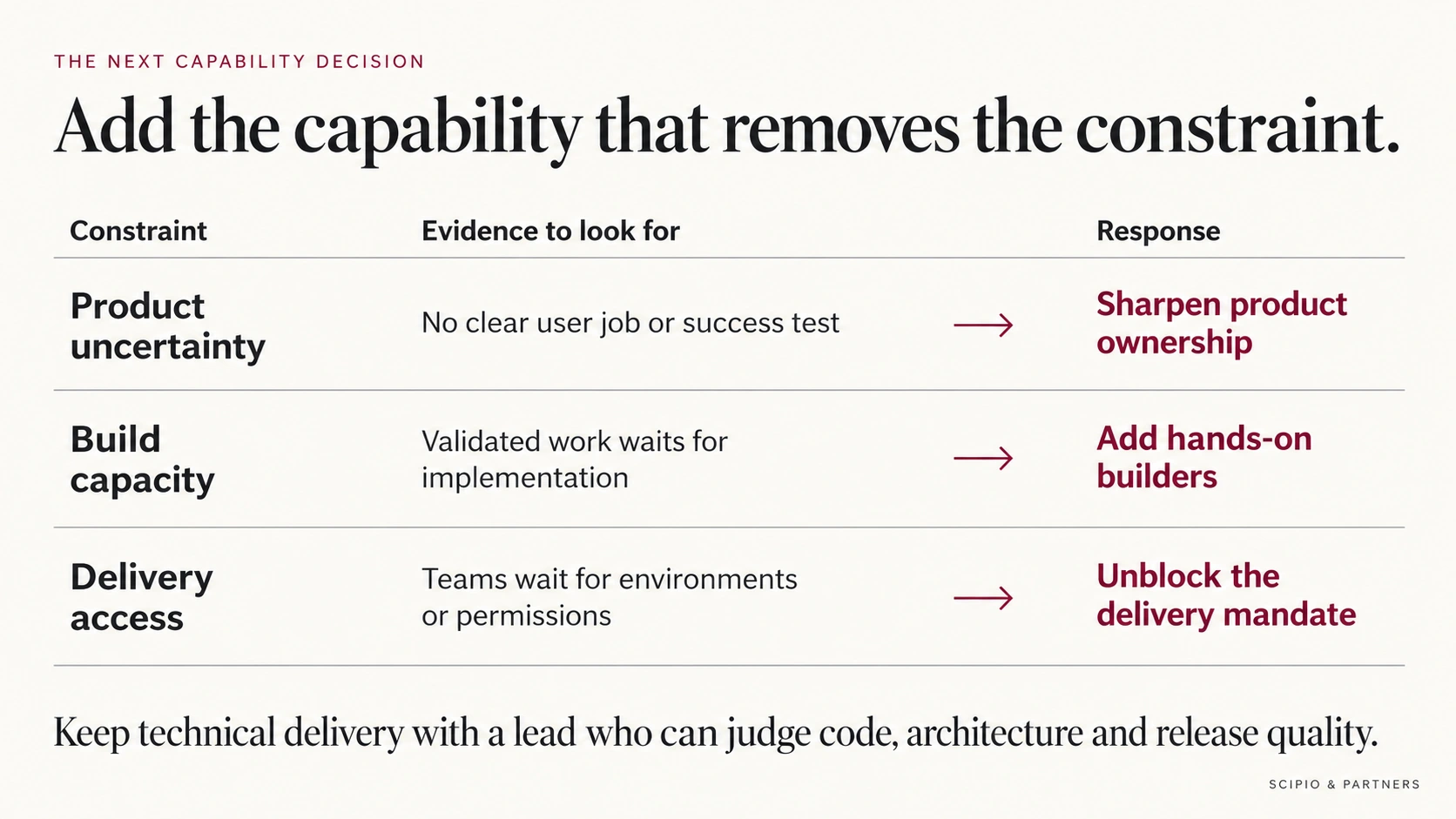
Use delivery evidence to decide which capability the team needs next.
Read the framework
- Product uncertainty
- If the user job or success test is unclear, sharpen product ownership. A product manager can improve discovery, scope, acceptance criteria and learning from users.
- Build capacity
- If validated work waits for implementation, add hands-on builders where delivery demand justifies the capacity.
- Delivery access
- If teams wait for environments or permissions, unblock the delivery mandate. Name the dependency owner and the access or infrastructure decision required.
- Technical accountability
- Keep technical delivery with a lead who can judge code, architecture and release quality. Diagnose the constraint before expanding the team; these responses address different problems.
3. Keep the team small enough to deliver.
Start with a technically credible delivery lead, a named business owner and enough hands-on capacity to complete the first useful release. Expand when demand and delivery evidence justify it. A separate VP layer, programme office and portfolio coordination team should each have to explain the constraint they remove. Senior titles do not create velocity; shorter paths between a decision, a build and a user can.
Exhibit 03
Three ways to organise the builders.
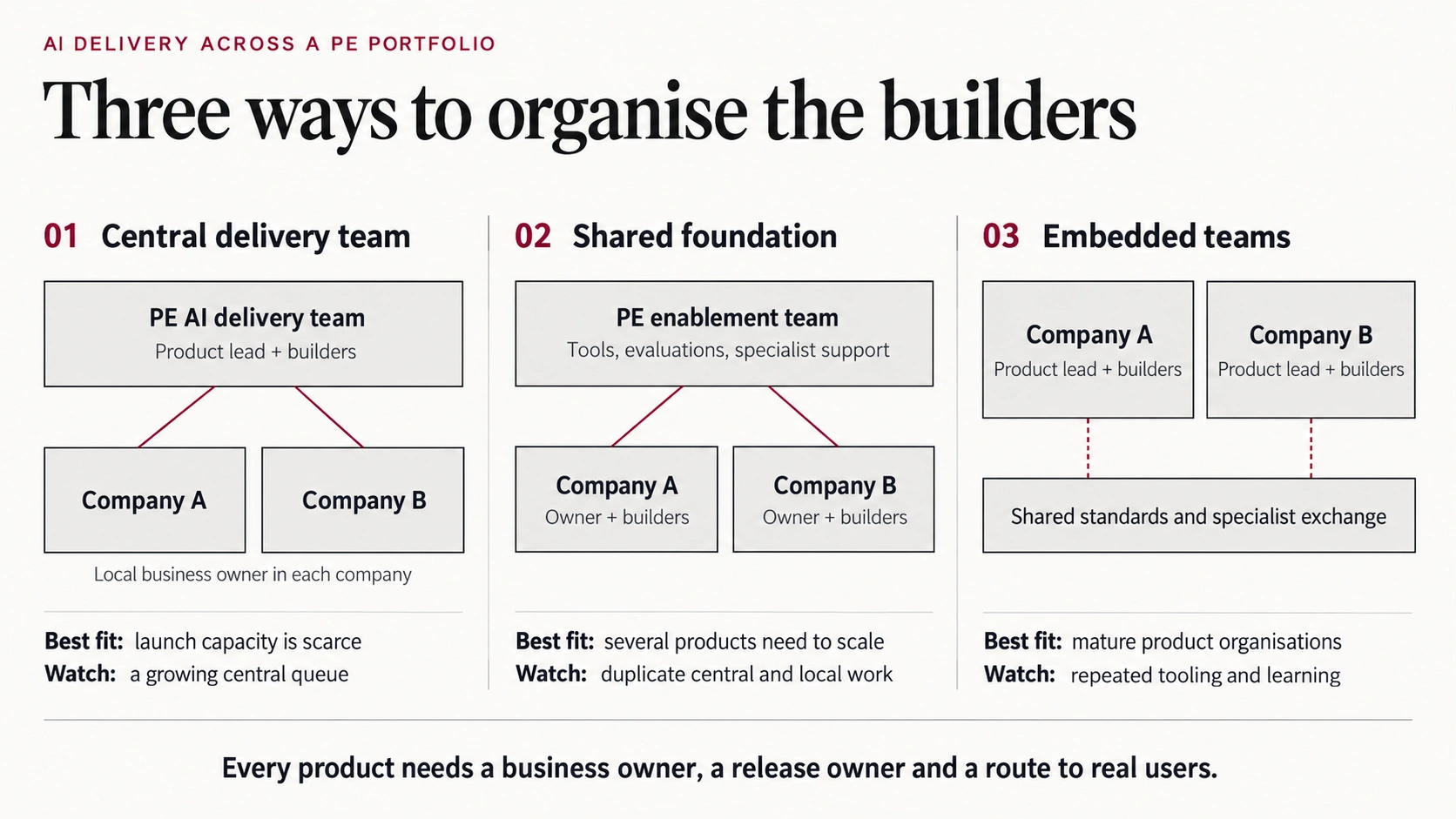
Choose according to company capability and concurrent delivery demand. Connectors show delivery and support relationships, not legal ownership.
Read the framework
- Central delivery team
- A PE AI delivery team contains product leadership and builders and serves Companies A and B. Each company retains a local business owner. Best fit: scarce launch capacity. Main constraint to watch: a growing queue for the central team.
- Shared foundation
- A PE enablement team supplies tools, evaluations and specialist support to local owner-and-builder teams in Companies A and B. Best fit: several products scaling concurrently. Watch for central and local teams duplicating the same work.
- Embedded teams
- Companies A and B each have product leadership and builders. They exchange specialist knowledge and share standards without a central delivery dependency. Best fit: mature product organisations. Watch for repeated tooling and learning.
- Accountability in every structure
- Each product needs a business owner, a release owner and a route to real users. These configurations are operating choices, not a mandatory maturity sequence.
Choose the structure around company capability and concurrent demand. A central team can supply scarce builders; a shared foundation can support local teams; established businesses may need their own embedded capability. These are operating choices, not steps towards an ever-larger central function. Reuse deployment tooling, evaluations and specialist knowledge where they save work. Keep company data, permissions and commercial accountability properly separated.
Protect time to finish. A flexible contractor or PM bench is useful when assignments have a bounded release and continuity through launch. Constantly moving people between portfolio requests creates unfinished work and repeated context recovery. Reserve capacity for supporting what is already live, then add builders as proven demand grows. A team that launches products faster than it can operate them is borrowing capacity from its future.
4. Make the CIO an enabler of delivery.
A fund can hire the right people and still neutralise them with infrastructure queues. If developers wait repeatedly for environments, approved model access, data permissions or deployment rights, the constraint sits outside the build team. The managing director and company leadership should make the CIO accountable for a usable route to production, with named owners and turnaround expectations for dependencies.
Give the delivery lead explicit authority within agreed boundaries: a budget, access to suitable cloud services, test data, environments and a way to release. Delegated authority should use scoped permissions, separate test and production environments, controlled credentials and observable changes. It should not mean an exception request for every ordinary development action. Escalate unresolved dependencies to someone who can decide them.
Bring legal, security and relevant compliance specialists into the first product brief. While builders test the user journey, those colleagues can resolve data use, access, contractual constraints and the conditions for wider release. Make required controls and decisions explicit early. A genuine issue may stop a release; vague concern should become a defined question with an owner, rather than an indefinite hold on the entire initiative.
Exhibit 04
Prepare the product and its permissions in parallel.
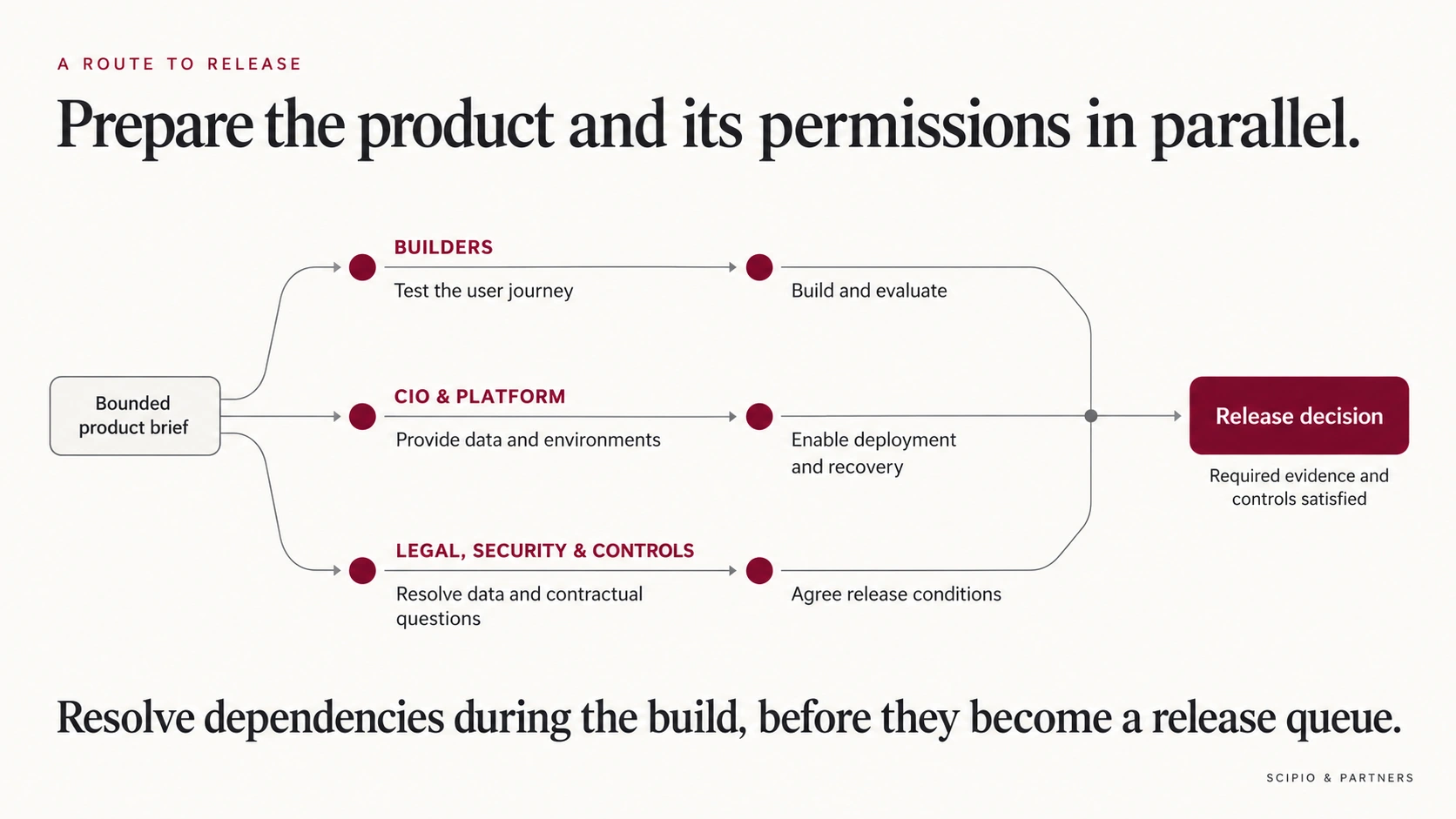
Give enabling teams work to resolve during the build, with clear conditions for release.
Read the framework
- One bounded product brief
- Start with an agreed user problem, scope and acceptance conditions. The brief informs all three workstreams concurrently.
- Builders
- Test the user journey, build the working product and evaluate its performance.
- CIO and platform
- Provide data and environments, then enable deployment and recovery within the agreed access boundaries.
- Legal, security and controls
- Resolve data and contractual questions and agree the conditions required for release.
- One release decision
- All three workstreams contribute to the decision. Required evidence and controls must be satisfied. Resolve dependencies during the build before they become a release queue; the diagram sets no fixed timetable.
Fund the essentials: AI development tools, repeatable deployments, evaluations, monitoring, rollback and enough cloud capacity to test properly. Measure their cost against the cost of idle builders and delayed evidence. Budget discipline should expose waste, including unnecessary platform construction; it should also make sensible spending easy. A shared platform earns expansion when real products need it, rather than when a central roadmap anticipates every possible use case.
5. Release quickly, then own what you release.
Expect the team to use AI-assisted development where it helps them build, test and investigate faster. Keep human ownership of design and code review. Aim for a narrow, working slice of the complete experience, then a bounded pilot with real users. Shorter scope creates earlier evidence. Removing the checks that make that evidence trustworthy creates rework.
Exhibit 05
Evidence that moves a product towards launch.
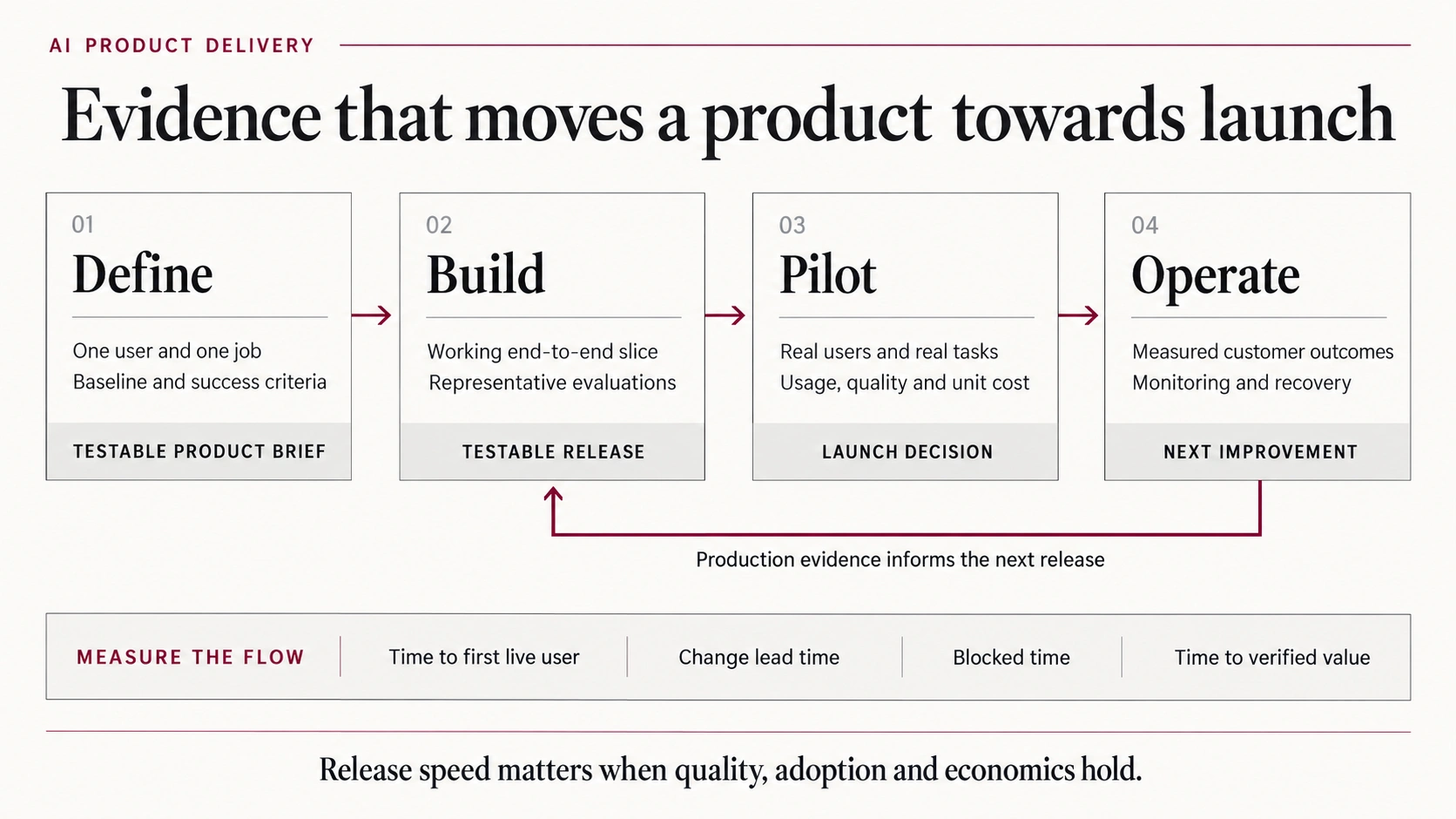
Stages define the evidence needed to proceed. They do not prescribe a fixed launch timetable.
Read the framework
- Define
- Identify one user and one job. Establish the baseline and success criteria. Output: a testable product brief.
- Build
- Deliver a working end-to-end slice and representative evaluations. Output: a testable release.
- Pilot
- Observe real users performing real tasks. Measure usage, quality and unit cost. Output: a launch decision.
- Operate
- Measure customer outcomes and establish monitoring and recovery. Output: the next improvement. Production evidence feeds back into Build for the next release.
- Measure the flow
- Track time to first live user, change lead time, blocked time and time to verified value. Read release speed alongside quality, adoption and economics.
Evaluate representative tasks, difficult cases and unacceptable actions. Use automated tests and human review where judgement matters; calibrate any model-based grading against people. Verify completed outcomes, not just convincing responses. Repeat trials to expose variability and rerun regression checks when models, prompts, tools or data change. Production monitoring then shows what the test set missed.
Invest in a dependable QA base. A capable QA partner can review permissions, integrations, failure recovery and critical user journeys while builders continue delivery. Agree acceptance conditions and responsibility for fixing defects. The technical lead still owns release quality. A small custom application is not inherently unreliable, but releasing one without testing, support and recovery creates avoidable operating risk.
Use a DevOps model in practice: the people building the product stay close to deployment, monitoring and incidents. Name an operating owner, reserve debugging capacity and establish a way to disable or roll back a failing feature. As usage grows, scale support deliberately. A launch creates an obligation to users; it does not end the assignment.
6. Run the portfolio from a live delivery dashboard.
Ask for a portfolio view you can inspect between meetings. One row per distinct solution should show the company, user problem, owner, lifecycle stage, time in that stage, last release, adoption, quality, spend and next decision. Link to the working product and its evidence. Include a last-updated timestamp and show missing data explicitly. A dashboard built from optimistic self-reporting is simply a presentation with a different interface.
The weekly review should answer what shipped, what moved, what is stuck and what needs a decision. Keep the essential product brief, architecture decisions, operating instructions and evidence of required controls. Avoid making builders recreate this information in a large recurring slide deck. Reporting should make the work inspectable with as little duplicate effort as possible.
Eight measures for the managing director
Solutions by stage
Count distinct solutions in discovery, prototype, pilot and production, plus paused and retired work. Show stage changes during the period. Track releases separately so minor updates cannot inflate the number of products delivered.
Age of unfinished work
Show days in the current stage and total elapsed time, including discovery. Identify the oldest items, especially those still in ideation, and the evidence or decision needed to move, narrow or stop them.
Time to first useful release
Measure from acceptance of a bounded brief to an intended user completing the target task in the live environment. Keep earlier discovery time visible. A prototype demonstration does not satisfy this measure.
Release speed and reliability
Track time from committed code to production, deployment frequency, failed changes and recovery time. Read these together: faster deployment has limited value if users inherit more failures.
Blocked time
Record time waiting for access, infrastructure, decisions, suppliers or review. Name the largest constraint and who can remove it. Show waiting separately from active development time.
Successful use and adoption
Track successful target tasks as a share of attempted tasks, repeat use by eligible user cohort, correction effort and unresolved quality failures. Define success and the observation window before interpreting the numbers.
Spend and unit economics
Show build investment, ongoing operating cost and cost per successful task. Include failed attempts, retries, human review and support. Keep shared costs visible and allocate them once. With no successful tasks, report the unit-cost ratio as undefined.
Verified value
Show the outcome, its baseline, supporting evidence and time to verification. Distinguish customer revenue, margin contribution, released capacity and cash savings. Record benefits once and have finance validate financial effects.
Do not turn solution count into a competition. A useful release can create more value than ten trivial applications. Compare delivery within a stable scope and show both completed and unfinished work. A growing ideation queue or rising spend without releases demands intervention, but a controlled product handling consequential decisions may reasonably need more evidence than a simple internal tool.
Use the dashboard to allocate capital and remove constraints. Add a builder when a validated backlog exceeds capacity; improve the user experience when adoption is weak; address reliability before widening use. Stop work when the hypothesis fails. Neither tokens consumed, impressive demos nor a busy roadmap substitutes for these decisions.
7. Let micro-apps earn the operating-model change.
I use ‘micro-apps’ to describe small, focused applications that remove friction from recurring work: preparing a customer brief, reconciling an exception or checking a handover. Some use AI at runtime; others are conventional applications built faster with AI assistance. Their importance lies in the task they improve. Repeated useful releases can expand what a portfolio company is able to do without a large transformation programme upfront.
The risk is a new version of application sprawl. Maintain an inventory from the first release: purpose, users, owner, data access, dependencies, running cost and support arrangements. Check whether a new request should extend an existing product. Retire duplicates and unused tools. Share components where they simplify maintenance. A small application still needs someone to update it when its model, API or source system changes.
Apply the same discipline to existing AI products. Inspect failed tasks, abandonment and support demand; distinguish a capability problem from an onboarding or workflow problem. Test one improvement hypothesis against the current baseline, release progressively and retain regression checks. Improving a product people already use may earn a better return than adding another application to the portfolio count.
I would use 12–18 months as a planning checkpoint for a broader operating-model and capacity review, once a meaningful set of releases has sustained adoption. It is a review point, not a forecast of savings. The evidence may support action earlier, or show that more work is needed. Within a PE investment cycle, this creates a practical route from delivery to resource decisions, provided the remaining holding period supports the investment case.
Size the future organisation against measured workload and service requirements. Include exceptions, rework, support and expected growth; verify whether saved time can actually be combined and redeployed. Then decide what capacity supports growth, what roles change and whether spending can fall. Do not book an FTE reduction because a prototype saves minutes in a demonstration. Released capacity becomes a cash saving only when the cost base changes.
8. Fund proof of value, then scale the builders.
Start the next assignment with a narrow product mandate, an accountable technical lead, a business owner and protected delivery capacity. Agree the spending envelope, first evidence review and route to users. Provide enough tooling, infrastructure and QA to make that commitment credible. Increase capacity as the team demonstrates delivery, adoption and an economically sound backlog. Keep support costs in the funding decision.
For the managing director, the strongest signal is a team that can show its work, explain its failures and release the next improvement. The warning is persistent dependence on hierarchy, suppliers and presentations to conceal an absence of delivery. Back the people who can build and judge quality, give them room to act, and hold them accountable for what remains in operation.
At Scipio & Partners, we have developed playbooks for PE houses facing these scenarios and have helped establish AI delivery setups across portfolio companies globally. Our work connects leadership selection, team structure, delivery authority, infrastructure, QA and portfolio reporting. We help firms avoid costly setup mistakes and turn early releases into an operating capability. Contact us to discuss the team, delivery mandate and investment sequence for your portfolio.

Five questions for your next portfolio review
- What can a real user do today that they could not do at our last review?
- Who can explain the architecture, inspect the code and take responsibility when the product fails?
- Which initiative has stayed in ideation or pilot too long, and what decision will move or stop it?
- What are adoption, quality and total cost telling us, beyond the number of releases?
- What evidence justifies the next builder, the next investment and any change in operating capacity?