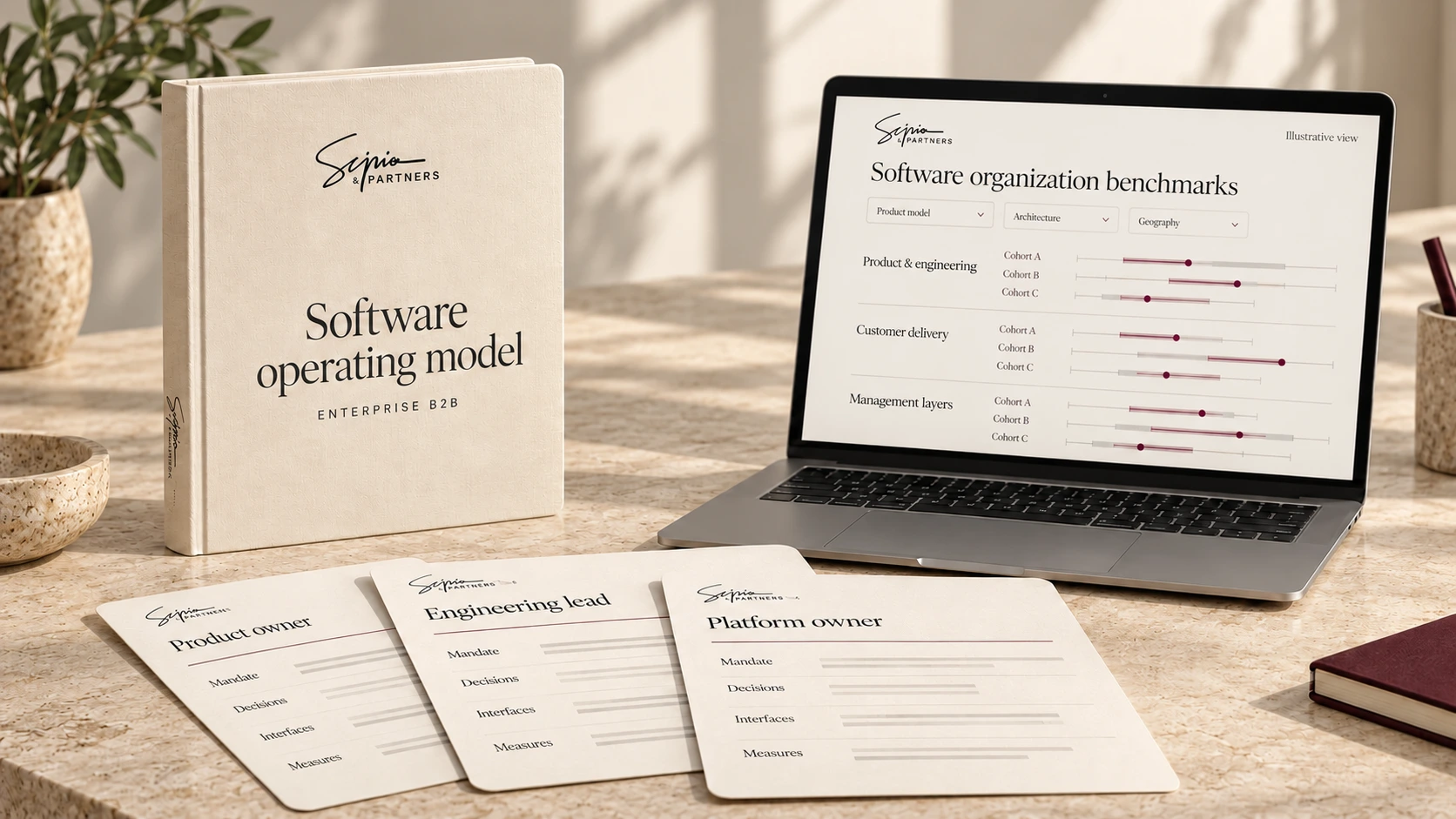
Insight · Enterprise B2B software
Redesign the work before resizing your software business.
Turn measured AI gains into a workable organization and a lower cost base across R&D, go-to-market, and customer operations.

At a glance.
Measure the human effort AI saves at the required output and quality.
Redesign roles so time saved becomes capacity you can reassign or remove.
Commit the savings after reinvestment, AI spending, and transition costs.
Key terms in plain English
Short explanations of the terms used in this article.
- R&D
- Research and development: the work of creating, improving, and maintaining the software product.
- go-to-market
- How a company reaches customers, sells its products, and grows revenue. It includes marketing, sales, and commercial partners.
- role model
- The design of roles in an organization: who owns which work, decisions, and responsibilities, and how the roles fit together.
- role charters
- Short descriptions of what each role owns, what it can decide, and when it must involve someone else.
- consolidation
- Combining time saved across tasks or people into capacity that can actually be reassigned or removed while maintaining service coverage.
- FTE
- Full-time equivalent: a measure of working capacity. Two half-time roles equal one FTE; it does not necessarily mean one person.
- fully loaded cost
- The full annual cost of a role, including salary, employer taxes, benefits, and any overhead included in the calculation.
- run rate
- The annualized saving once the change is fully in place. It differs from first-year savings, which reflect timing and transition costs.
- tokens
- Small units of text or other content processed by an AI model. Usage-based AI charges often depend on the number of input and output tokens.
Hover, focus, or tap a dotted-underlined term for a short explanation.
Redesign the work before deciding how many people your software business needs. Measure the effort AI saves, turn that time into usable capacity, and deduct the full cost of change before committing the savings.
In our conversations with B2B software leaders this year, one question keeps returning: how far can we resize Research and development: the work of creating, improving, and maintaining the software product., How a company reaches customers, sells its products, and grows revenue. It includes marketing, sales, and commercial partners., and customer operations as AI takes on more work?
The difficulty is that AI changes activities before it changes jobs. Faster coding can leave release queues untouched. Automated sales preparation can save time without reducing account coverage. A smaller support team can move unresolved work into engineering. The workforce plan has to follow the redesigned work.
1. Prove how much work AI removes.
Measure the human effort required to deliver an accepted outcome with and without AI. Compare the same type of work, product, and customer segment. Include review, rework, exceptions, and work passed to another team.
Published results show why the baseline matters. Three field experiments covering 4,867 developers estimated about 26% more completed tasks with AI assistance. In METR's early-2025 study, 16 experienced developers took 19% longer on familiar repositories. Its 2026 follow-up highlighted selection effects that complicate newer estimates. The relevant planning baseline is the gain measured in your own workflows.1, 2, 3
Measure the gain where each function creates value.
- R&D
Reduce effort per accepted change.
Measure effort from development to release. Maintain quality, reliability, and operating coverage.
- Go-to-market
Improve productive coverage.
Track pipeline, conversion, and bookings per seller. Preserve account coverage and sales effectiveness.
- Customer operations
Lower cost to serve.
Measure effort per implementation or resolved case. Maintain service levels, adoption, and renewals.
Test one representative R&D workflow and one commercial or customer-operations workflow. Agree the output and quality requirements first. The result should be a measured reduction in effort by work type, ready to translate into roles.
2. Turn saved time into usable capacity.
The The design of roles in an organization: who owns which work, decisions, and responsibilities, and how the roles fit together. determines whether saved time can change headcount. Time released across ten specialists does not remove a position while all ten still own essential obligations. Consolidate the work, reassign responsibilities, and preserve service coverage.
Start with the work the business commits to doing. AI may make a custom feature cheaper to build while leaving years of maintenance and support. Decide which requests to standardize, price, or refuse before sizing the team.
Exhibit 01
AI changes the whole software operating model.
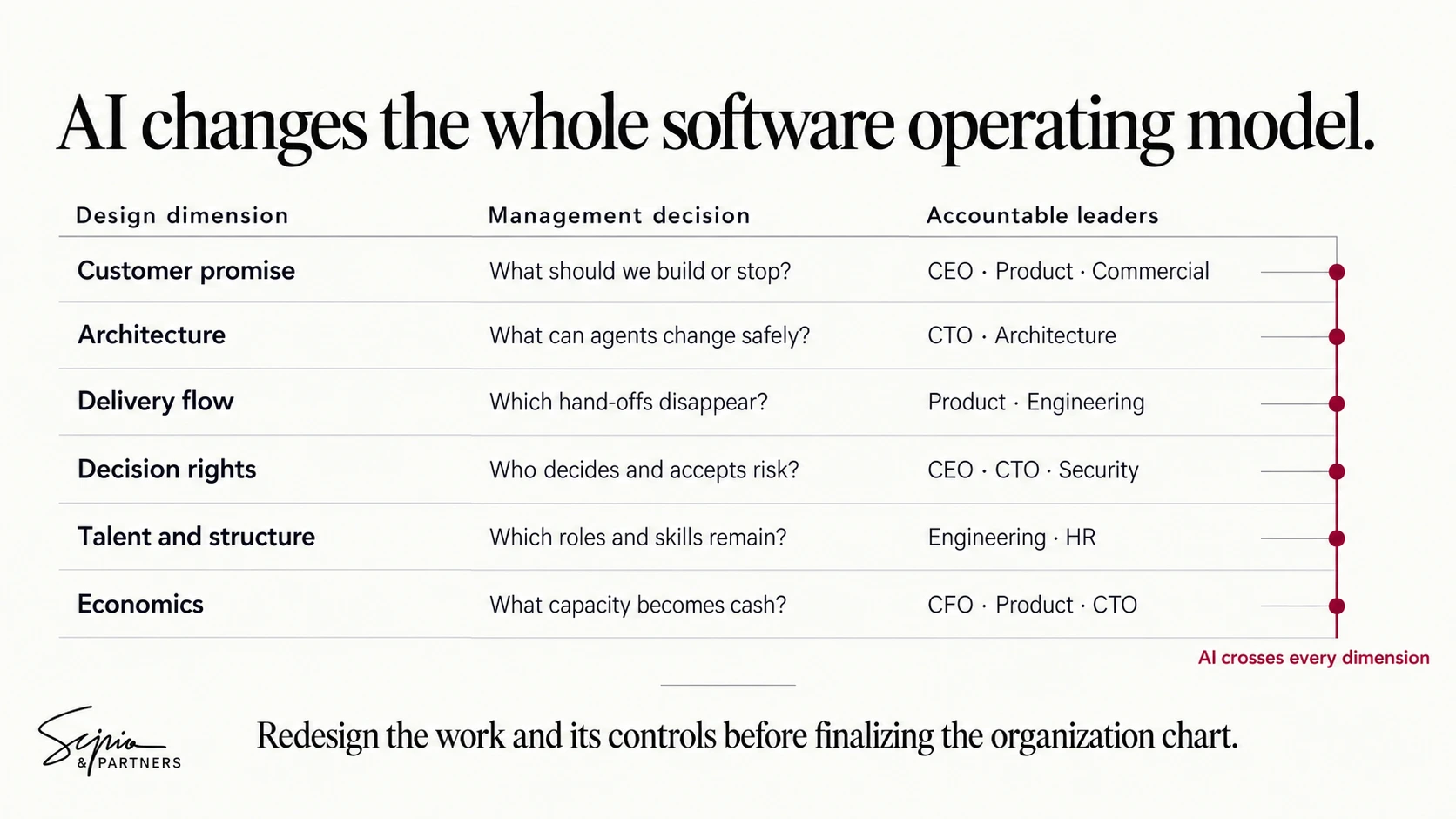
Redesign the work and its controls before finalizing the organization chart.
Read the framework
- Customer promise
- Decide what to standardize, customize, and refuse. Include the implementation and support work created by each commitment.
- Architecture
- Define where agents can make changes. Use modular interfaces, tests, and secure environments to set the automation boundary.
- Delivery flow
- Remove repeated handoffs between sales, implementation, product, and support. Keep ownership clear from commitment to outcome.
- Decision rights
- Name who can approve product scope, technical exceptions, risk, and release. Set the escalation boundary for each decision.
- Talent and structure
- Define the roles, skills, and coverage the redesigned work requires. Then set reporting lines and funded positions.
- Economics
- Allocate usable capacity to growth, avoided hiring, or lower recurring cost. Include the AI spending required to deliver it.
Group work around product outcomes that a team can own. Bring product judgment, engineering, and operational responsibility together, supported by shared platforms and specialist assurance. Name who controls scope, architecture, and release so faster delivery does not create another queue.
Exhibit 02
Broader product teams need explicit decision rights.
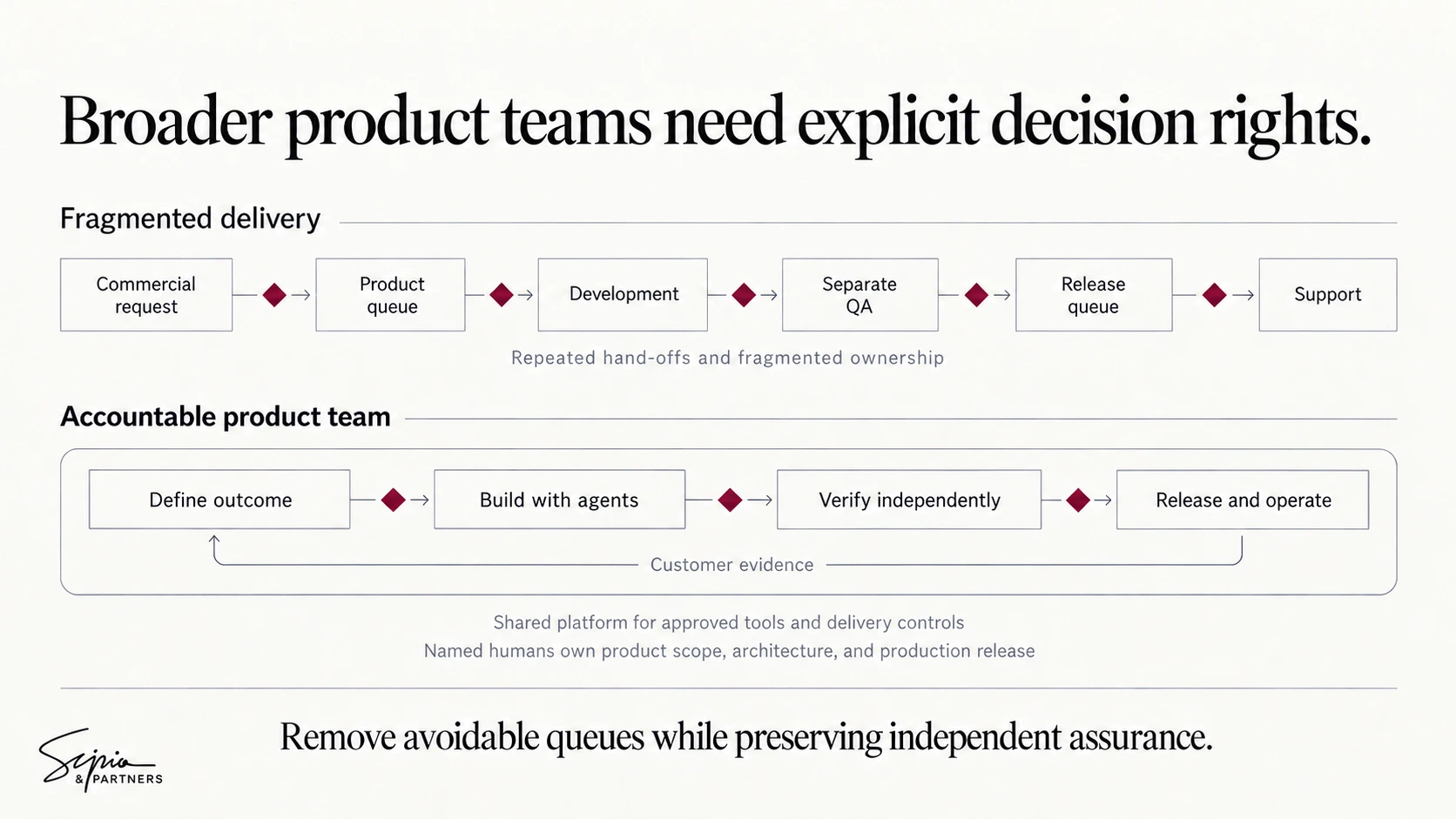
Remove avoidable queues while preserving independent assurance.
Read the framework
- Fragmented delivery
- Separate sales, product, development, QA, release, and support queues create handoffs and split accountability.
- Accountable product team
- One team owns the outcome through definition, development, verification, release, and operation.
- Shared foundation
- Shared platforms supply tools, tests, and telemetry. Named owners retain authority over scope, architecture, and release.
- Independent assurance
- Preserve independent checks through peer review, specialist assurance, and enforceable release controls.
Apply the same logic to management layers: retain decisions, coaching, and operational ownership; remove coordination made unnecessary by the new workflow. In a software group, test which platform and specialist responsibilities can be shared across businesses.
Use Short descriptions of what each role owns, what it can decide, and when it must involve someone else. to record the decisions each role owns, the work AI performs, and the skills and coverage still required. This is the target organization: a role map that shows which capacity can be reinvested and which can leave the cost base.
3. Put the net savings into the budget.
Decide how much usable capacity goes to additional output, avoided hiring, or lower recurring spending. Capacity retained for growth cannot also be counted as a payroll saving. The financial case must reconcile that allocation with AI costs and the timing of the change.
Exhibit 03
Released capacity becomes savings only through a funded decision.
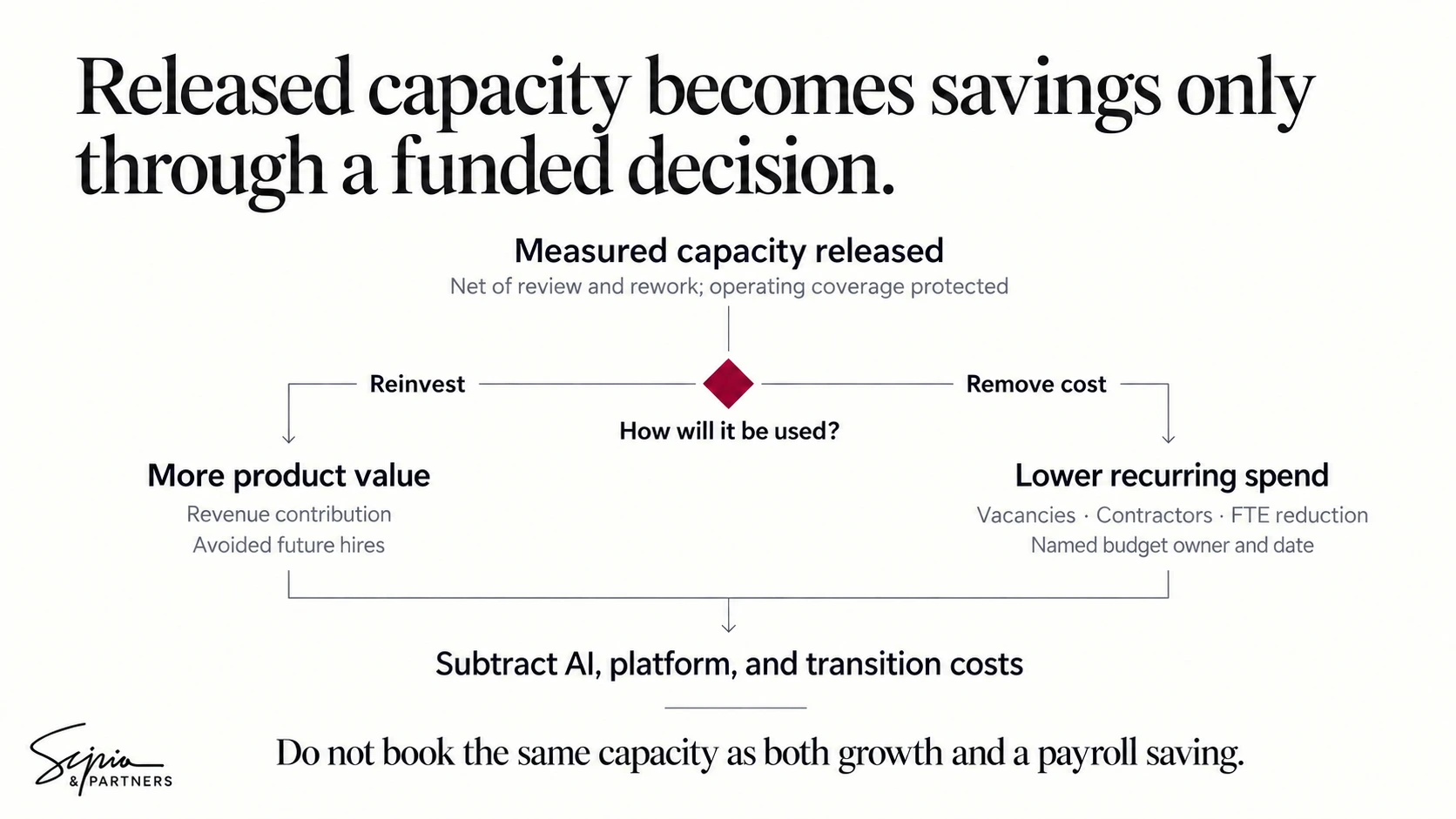
Choose where the capacity goes and reconcile the decision to the budget.
Read the framework
- Measure released capacity
- Measure time saved after review and rework, then identify how much can be consolidated into usable capacity.
- Reinvest
- Assign capacity to additional product or customer work. Reinvestment can avoid future hiring while leaving current payroll in place.
- Remove cost
- Identify the roles or contracts that leave recurring spending. Give each budget change an owner and an effective date.
- Calculate the net result
- Deduct added AI and platform costs from recurring savings. Apply implementation timing and transition costs to the first-year result.
Interactive workforce scenario
Choose where the capacity goes.
Switch the allocation. Adjust the assumptions. See the result here.
Live scenario result
Lower FTE requirement
6.06.0% of starting FTEAnnual net saving
€480,000After AI and platform costFirst-year impact
€180,0008.0 FTE eq. usable: 2.0 reinvested + 6.0 removed from cost.
Allocation presets change reinvestment; all other inputs remain as entered.
Review assumptions and calculation
- Product and engineering team
- 100.0 FTE
- Effort AI can address
- 40.0 % of total effort
- Net time saved on that work
- 30.0 % after review and rework
- Released time you can consolidate
- 66.7 % of released capacity
- Usable capacity to reinvest
- 25.0 % retained for other work
- Fully loaded cost per FTE
- 120,000.0 EUR per year
- Additional AI and platform cost
- 240,000.0 EUR per year
- One-time transition cost
- 300,000.0 EUR
- Delay before labor savings begin
- 0.0 months
- Time released
- 12.0 FTE eq.
- Gross annual labor savings
- €720,000
- Simple payback from project start
- 7.5 months
Released capacity = FTE in scope × addressable effort × net time saving. Usable capacity = released capacity × consolidation share. Lower FTE requirement = usable capacity × (1 − reinvestment share).
Annual net saving = removed FTE equivalents × fully loaded cost − additional annual AI and platform cost. First-year impact applies the selected delay to labor savings, then deducts a full year of AI costs and all transition costs.
AI spending starts immediately. Labor savings begin in full after the selected delay. Payback includes AI spending during that delay. The model excludes revenue gains, tax, discounting, and a gradual rollout.
Run R&D, go-to-market, and customer operations as separate scenarios using each function's measured workload, time savings, and costs.
Translate the scenario into budget decisions. Name the roles or contracts that change, assign an owner and effective date, and include AI subscriptions, Small units of text or other content processed by an AI model. Usage-based AI charges often depend on the number of input and output tokens. consumption, platform costs, and transition spending.
Require three signed-off outputs before changing the workforce plan.
- 01
A proven capacity baseline
The CTO, CRO, and customer leaders verify work removed, output maintained, and quality.
- 02
An executable role model
Function leaders and HR define roles and handoffs. The CEO resolves trade-offs and confirms coverage.
- 03
A funded transition plan
The CFO confirms net savings and timing. Assign every cost change an owner and review results monthly.