Insight · Finance & leadership
CFOs: midnight is not a performance metric.
A CFO agenda for 2026–27: challenge the layers, back good judgement and use AI to change the work.

At a glance.
Treat recurring midnight work as a management problem that deserves investigation.
Pair financial judgement with engineering, then reassess roles, layers and pay.
Make it safe to challenge the system—and show people what changed.
Recently, an experienced finance professional told me about his probation at a well-known fashion business. He described being told to stay until midnight, work harder and make his commitment more visible. The instruction came without additional capacity to deliver the work.
This was an ambitious, highly qualified person with solid judgement. He had worked that way before. His reluctance to repeat it struck me as evidence of experience. He understood the difference between a difficult assignment worth solving and an expectation that exhaustion would become part of the job.
The brand was attractive. The management message was ugly.
For a CFO planning the finance function of 2027, this should land as an operating problem. You can approve an AI programme, talk about productivity and recruit excellent people while managers underneath you continue rewarding visible suffering. Those choices pull in opposite directions. Eventually, the people with options will notice.
1. Stop treating exhaustion as evidence of commitment.
I expect finance professionals to take responsibility. A transaction, a serious control issue or an unexpected business event can demand an exceptional effort. The revealing question is what happens afterwards. Does the manager remove the cause, or does the exceptional effort quietly become next month’s staffing model?
When someone is repeatedly working until midnight, I want to know which reports are still useful, where data arrives late, how many people review the same output, what decisions keep coming back and which tasks should already have been automated. Telling that person to demonstrate more hunger avoids every one of those questions.
As CFO, you need to examine the managers who translate your ambition into daily expectations. A VP who delivers the pack on time by making everyone afraid to leave can look effective from several floors above. Inspect the rework, turnover, unresolved dependencies and hours needed to produce it. Ask the team what the manager has actually made easier.
A fashionable employer brand buys attention. The experience of working for your managers determines whether that attention becomes trust. Your culture is being written in probation reviews and ordinary conversations, including the ones you never attend.
2. Make every management layer earn its place.
My starting hypothesis for an AI-enabled finance function is fewer layers between a problem and someone empowered to solve it. I would test that hypothesis seriously. A structure built around collecting updates, consolidating files and passing work upwards deserves to be redesigned when the work changes.
Take the organisation chart into a room and ask what each layer contributes. Which decisions does this director make? What risk does this VP own? What capability does this manager develop? What would slow down or become unsafe if the hand-off disappeared? Answers about status, historical precedent or the number of people supervised are insufficient.
Exhibit 01
Decision rights reveal which layers add value.
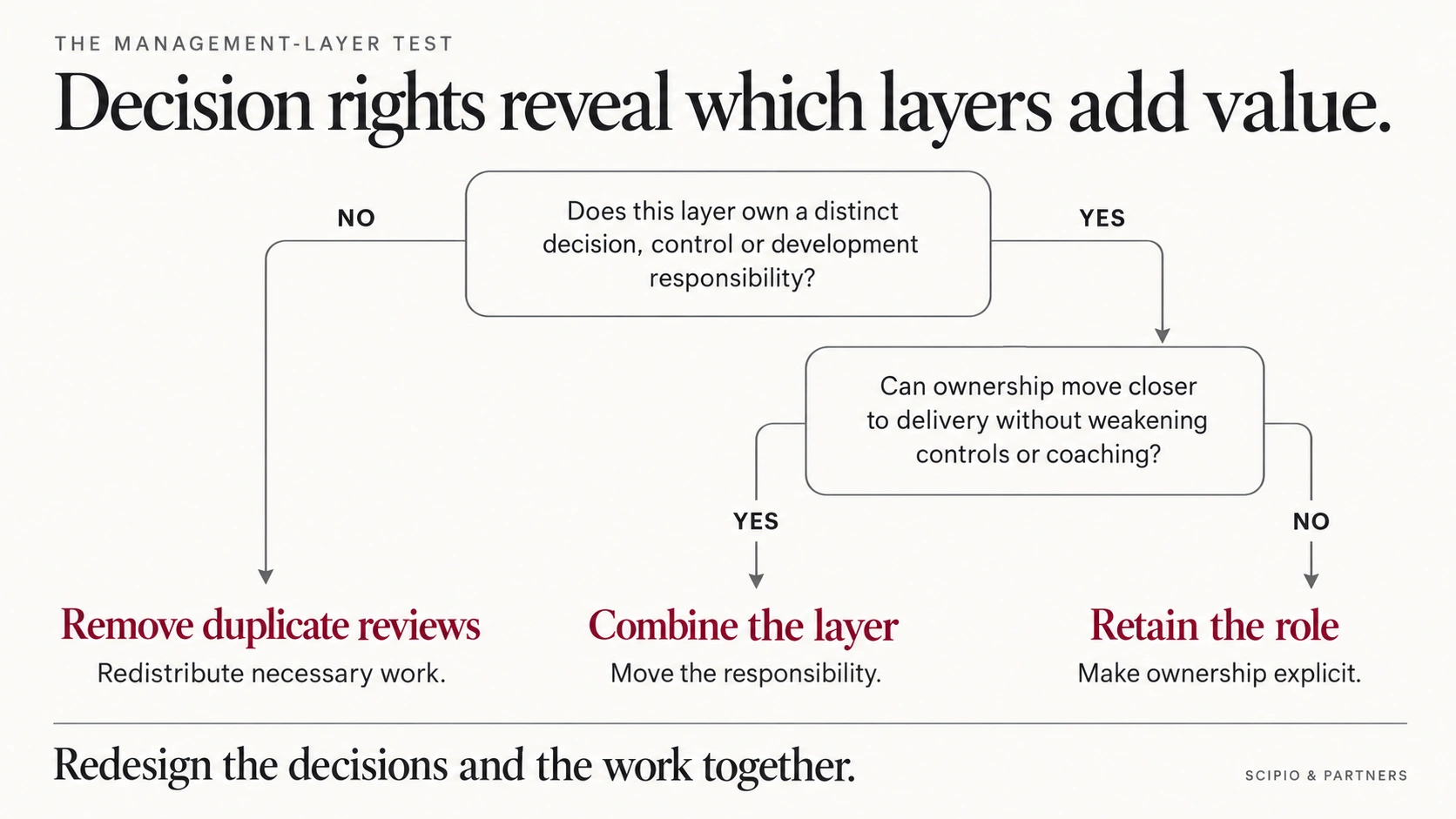
Test the responsibility before deciding which layer should carry it.
Read the framework
- First test — a distinct responsibility
- Does this layer own a distinct decision, control or development responsibility? If no, remove duplicate reviews and redistribute necessary work. If yes, apply the second test.
- Second test — ownership closer to delivery
- Can ownership move closer to delivery without weakening controls or coaching? If yes, combine the layer and move the responsibility. If no, retain the role and make its ownership explicit.
- The design rule
- Redesign the decisions and the work together. Necessary work, controls and coaching still need an accountable owner.
Some senior roles will become more important. Technical accounting, treasury, commercial judgement, control ownership and difficult investment decisions require real depth. Preserve that expertise. Challenge the layers whose principal output is another review meeting or a repackaged version of somebody else’s analysis.
A smaller leadership structure also needs explicit decision rights and enough capacity to coach people. Simply removing a manager and transferring the same approval burden to the remaining team recreates the midnight problem under a leaner chart. Redesign the decisions and the work together.
3. Put builders next to the people who understand the numbers.
Finance has plenty of people who can describe a painful process. Give some of them the means to change it. Pair an experienced finance operator with an engineer who can connect systems, build a workflow, test it and keep it running. Let a finance owner decide what good looks like and a technical owner take responsibility for delivery.
Start with work that is repetitive and inspectable: assembling source data, proposing transaction matches, preparing an exception queue or drafting commentary from reconciled results. AI-assisted reconciliation and summaries are already available in finance tools. The useful question for your team is which steps can be trusted in your environment, with your data and your controls.
Exhibit 02
Put financial judgement and engineering in one delivery team.
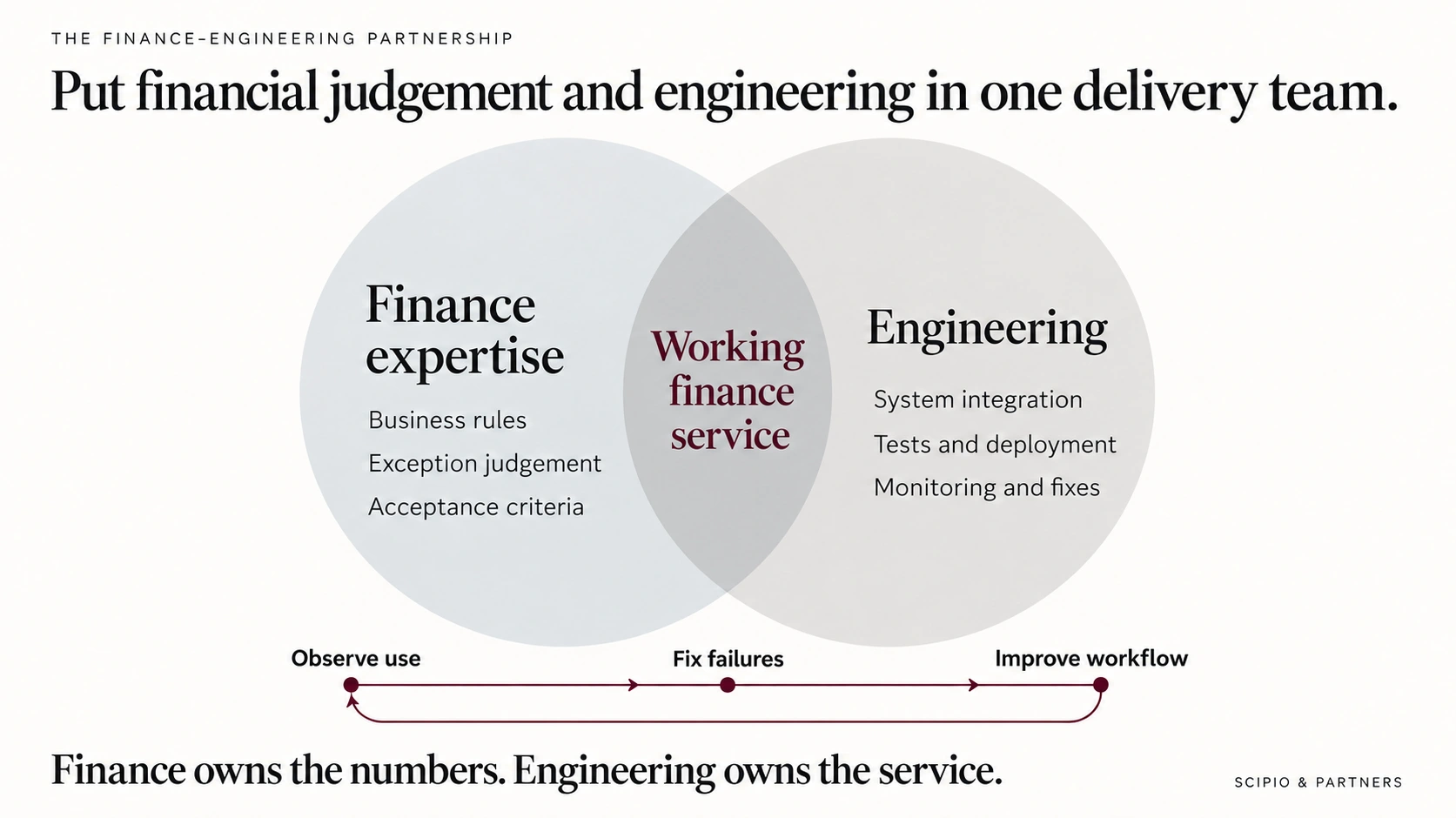
Combine complementary expertise, with clear ownership after launch.
Read the framework
- Finance expertise
- Define business rules, apply exception judgement and set acceptance criteria. Finance remains accountable for the numbers.
- Engineering
- Connect systems, test and deploy the workflow, monitor it and fix failures. Engineering owns the reliable operation of the service.
- A working finance service
- Both capabilities contribute to the same release. Their overlap represents a shared working service, with distinct financial and technical accountabilities.
- An ongoing operating loop
- Observe use, fix failures and improve the workflow, then observe again. Delivery includes support and improvement after launch.
Keep the arithmetic and accounting rules reproducible. Use AI to assist with messy inputs, classification, explanations and investigation; retain traceable sources, rule-based checks and accountable review for consequential outputs. A fluent explanation of a variance is not evidence that the variance was calculated correctly. Statutory consolidation, judgement and sign-off deserve more than a confident answer in a chat window.
Work with the CIO to provide approved data access, a usable development environment, a route to release and someone to support what goes live. Involve security and control owners while the process is being built. A DevOps approach matters here: the builders remain responsible for testing, deployment, monitoring and fixing failures. Finance should have a working service, not a succession of demonstrations.
Spreadsheets can remain a useful interface. The dependency worth breaking is the ritual of exporting, copying, checking and circulating the same numbers by hand. A faster spreadsheet process may be a good first release. It should also expose the next piece of work that can disappear.
4. Pay exceptional people without making them collect direct reports.
If the only route to a serious salary is a director title and a larger team, do not be surprised when talented people accumulate both. Your reward system is purchasing hierarchy.
I would make room for highly paid individual contributors with financial judgement, operational depth and the ability to improve a process. Someone who understands the numbers, spots a weak assumption and works with engineers to eliminate recurring effort can be worth more than several layers of coordination. Give that person authority, visibility and a credible career.
Pay for the scope and consequence of decisions, scarce expertise, reliable delivery and the ability to make colleagues better. Assess managers on the capability they build and the friction they remove. Avoid incentives based only on headcount reduction or the number of automations launched: both are easy to improve while leaving a worse operation behind.
Keep a route for people to acquire judgement. Juniors need supervised exposure to exceptions, reconciliations and business decisions, even as routine preparation becomes automated. Otherwise, you will consume today’s expertise while neglecting the people who should replace it. A flatter function needs deliberate development, not a permanent dependence on a few exhausted experts.
5. Give people a route to you that does not run through the problem.
An open-door statement is cheap. A person in probation is calculating what happens after they walk through it. If the manager controls their future, or the CFO has a reputation for treating difficult feedback as disloyalty, an invitation on the intranet will achieve very little.
Set a clear standard for management feedback. Critique the work, define the gap, agree the priority and identify the support needed. Ban the use of late-night visibility as a proxy for ambition. Ban vague loyalty tests and retaliation against people who raise a concern in good faith. A demanding function can be precise about performance without making fear part of the process.
Exhibit 03
Turn feedback into an agreement people can act on.
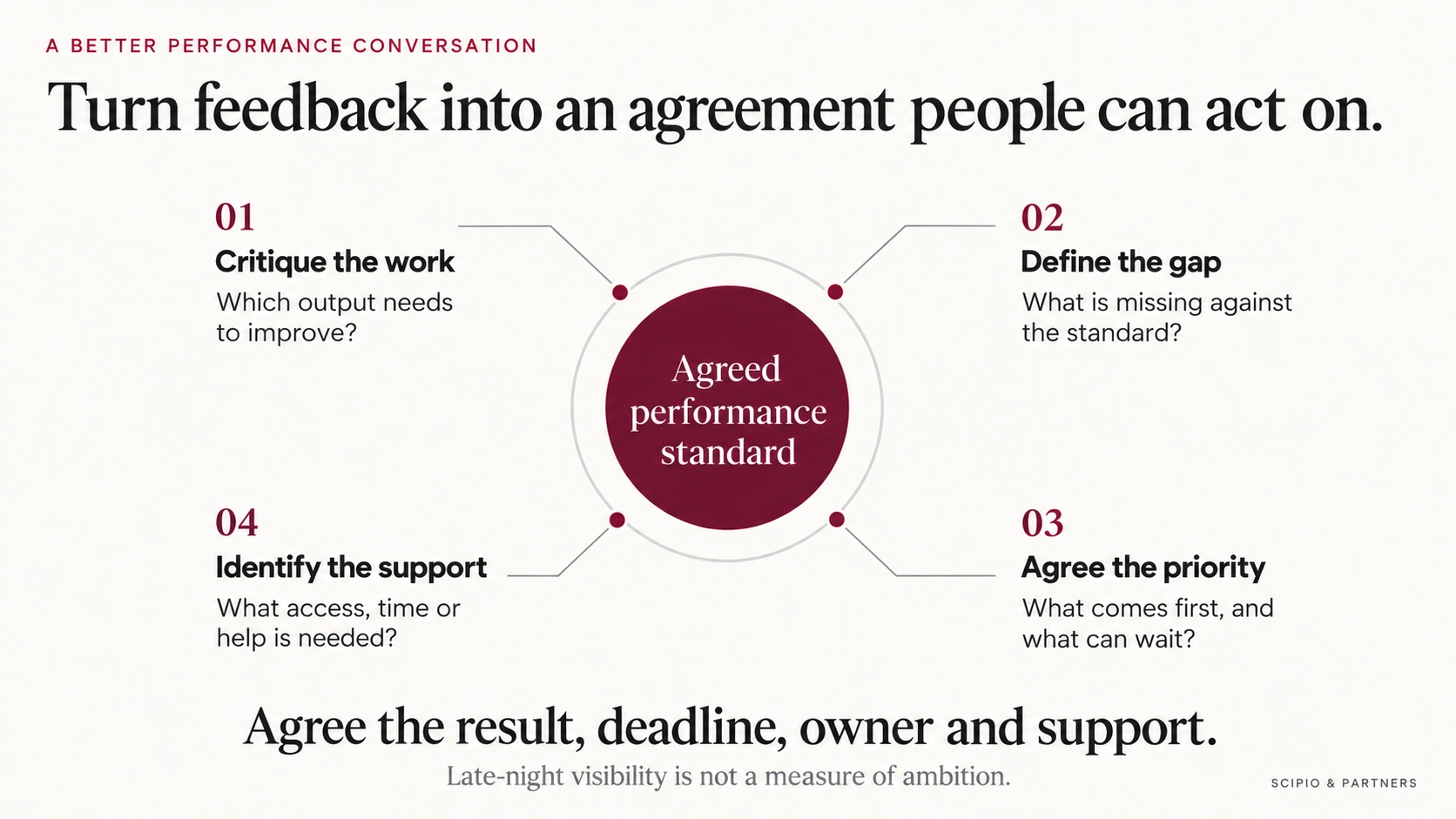
A clear performance conversation makes the expected result and the means to deliver it explicit.
Read the framework
- 01 — Critique the work
- Which output needs to improve? Discuss the work against an agreed performance standard.
- 02 — Define the gap
- What is missing against the standard? Make the required improvement specific.
- 03 — Agree the priority
- What comes first, and what can wait? Resolve competing demands explicitly.
- 04 — Identify the support
- What access, time or help is needed? Specify the resources needed to deliver.
- The agreement
- Agree the result, deadline, owner and support. Late-night visibility is not a measure of ambition.
Provide a route outside the reporting line, with direct access to the CFO or a trusted, independent recipient who can escalate. Tell people who will see their report, how it will be handled and when they should expect a response. Include an independent route for concerns involving the CFO. Check back after the initial conversation; retaliation can arrive as an assignment change or a suddenly hostile performance review.
You do not need to adjudicate every disagreement personally. You do need to see patterns, intervene when the same behaviour recurs and hold leaders accountable. Protect identities when communicating what changed. A channel that collects complaints without action teaches people that management already knows and has chosen to tolerate the problem.
If people are afraid to approach you, start there. Your own reaction to unwelcome information sets the ceiling on the honesty of everything reported upwards—including your transformation dashboard.
Questions a CFO should be willing to ask directly
- What happens here when someone says the deadline cannot be met with the available capacity?
- Which recurring task would you stop if you did not need your manager’s permission?
- Have you been asked to demonstrate commitment through hours rather than an agreed result?
- What changed after the last concern someone raised?
6. Run a sizing experiment before announcing a savings number.
I would use the remaining 2026 planning window to fund a bounded experiment for 2027. Choose one finance process with a clear owner and enough recurring work to observe. Establish the current effort, elapsed time, errors, exceptions and service requirements. Include the work currently being absorbed after hours. Otherwise, your baseline already assumes free capacity.
Remove reports and approvals that nobody can justify. Then give a small finance-and-engineering team protected time to rebuild the remaining flow. The daily workload must be reprioritised or covered; making people transform the function after finishing their normal job would repeat the behaviour this article challenges.
Exhibit 04
Redesign the work. Then resize the function.
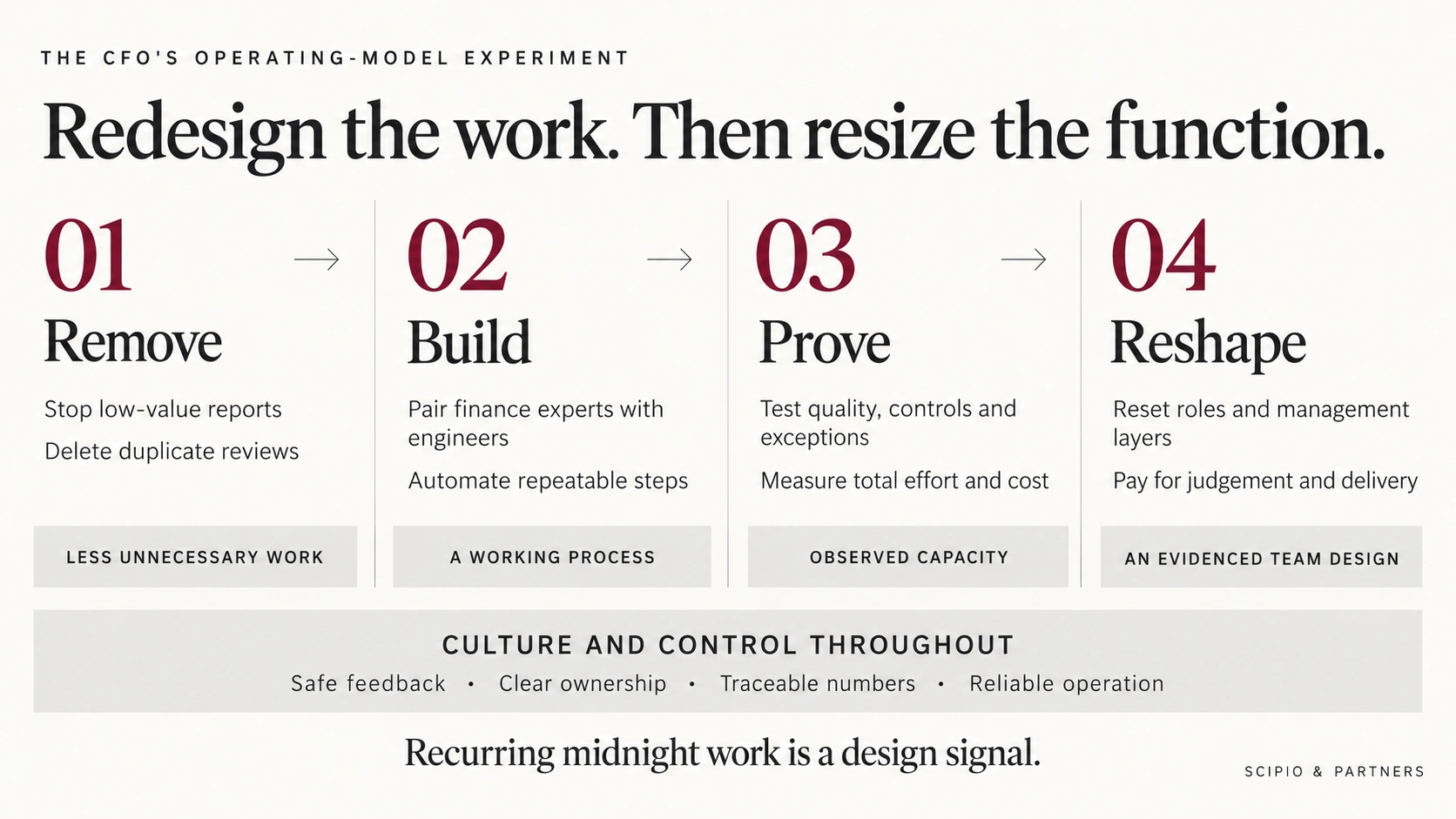
Connect process improvement to an evidenced team design, with culture and control throughout.
Read the framework
- 01 — Remove
- Stop low-value reports and delete duplicate reviews. Outcome: less unnecessary work.
- 02 — Build
- Pair finance experts with engineers and automate repeatable steps. Outcome: a working process.
- 03 — Prove
- Test quality, controls and exceptions. Measure total effort and cost. Outcome: observed capacity.
- 04 — Reshape
- Reset roles and management layers. Pay for judgement and delivery. Outcome: an evidenced team design.
- Culture and control throughout
- Maintain safe feedback, clear ownership, traceable numbers and reliable operation at every stage. Recurring midnight work is a design signal.
Test the new process through representative operating cycles, including peak work and exceptions. Count review, debugging, maintenance and support. Compare the result with the baseline before deciding what capacity can move to analysis, business partnering or growth, and what cost can genuinely leave the function. Time saved in scattered fragments is not automatically a removable role.
Then revisit the leadership structure and salary model. You may need fewer coordination roles, more engineering capability and better-paid finance specialists. You may also discover a control or expertise gap that needs investment. The purpose is to design the function around observed work, rather than protect every existing box or hit an arbitrary reduction target.
Give yourself a live view of cycle time, first-pass quality, exception backlog, after-hours effort, operating cost and decisions waiting for approval. Read the measures together. A faster close achieved through more rework or hidden overtime is a poor result. A rising number of reported concerns can mean people finally trust the channel; silence is no proof of a healthy culture.
7. The first thing to modernise is what you reward.
For 2027, I would ask every finance leader to show three things: work their team no longer needs to do, a decision that has become faster or better, and evidence that people can challenge a broken process without paying for it personally. That would tell me more than a count of AI licences or a presentation about the future of finance.
Lead visibly. Ask your own team to challenge the reports you request. Stop rewarding the person who sends the latest email. Sponsor a working release, remove a blocked dependency and acknowledge someone who eliminated a task you once insisted on. Your peers will understand ambition more clearly when they can see it operating.
This is where my work on finance operating models and technology delivery comes together. At Scipio & Partners, we connect the design of the organisation with the practical work of changing processes, enabling teams and delivering technology. The conversation belongs with the CFO, CIO and business leadership together: what should finance do, what should it stop doing, and what capability will make the new model work?
I keep returning to that colleague. He was ready to contribute judgement and experience. The message he described asked him to prove commitment by staying later. As CFO, you can choose a better bargain: pay good people well, give them the means to build a better function and hold them accountable for the result.
If midnight is still your test of ambition in 2027, the first performance review should be your own.