Insight · Corporate strategy & governance
Shareholder activism: earn the mandate.
A board agenda for testing strategy, capital allocation and the ability to deliver under shareholder scrutiny.

At a glance.
Test the economic criticism, the proposed remedy and the delivery team separately.
Compare strategic alternatives after funding, separation costs and execution risk.
Turn shareholder support into a measurable mandate that survives the campaign.
A board can win a shareholder vote and still lose the argument about its business. It can also reject an activist’s proposed solution while accepting that the underlying criticism is correct. Those distinctions should sit at the centre of any serious response to shareholder activism.
For a chair, CEO or CFO, the uncomfortable question is straightforward: if an informed investor rebuilt our strategy from the outside, which decisions would be hardest to defend? A business that absorbs capital without earning an adequate return. A portfolio whose shared benefits nobody can quantify. An operating plan that keeps promising the same improvement. A board whose experience no longer matches the work ahead.
The strategy adviser’s job is to make those questions answerable. Legal rights, election mechanics and communications matter enormously, but they cannot manufacture a convincing economic case. Our starting point at Scipio & Partners is the value available to the business, the alternatives for realising it and the organisation capable of delivering it.
That approach is useful before a campaign begins—and indispensable once an investor challenges who should control the next set of decisions.
1. Separate the criticism from the remedy—and the remedy from the team.
An activist campaign often links three propositions: performance is inadequate; a particular transaction or operating change will improve it; and different directors are needed to make it happen. Each proposition requires its own evidence. Agreement with the first does not automatically establish the second or third.
Start by reconstructing the strongest version of the investor’s argument. Identify the specific earnings, cash-flow, capital-allocation or governance gap. Then test the proposed response against credible alternatives, including a materially improved version of the current plan. Finally, assess the capabilities and accountability required to execute the preferred route.
Apply the same discipline to management. A board cannot dismiss a separation proposal because it involves execution risk while treating its own transformation as certain. Nor should an impressive nominee biography substitute for evidence that the proposed board can oversee the decisions this business actually needs.
Exhibit 01
A valid criticism is only the first test.
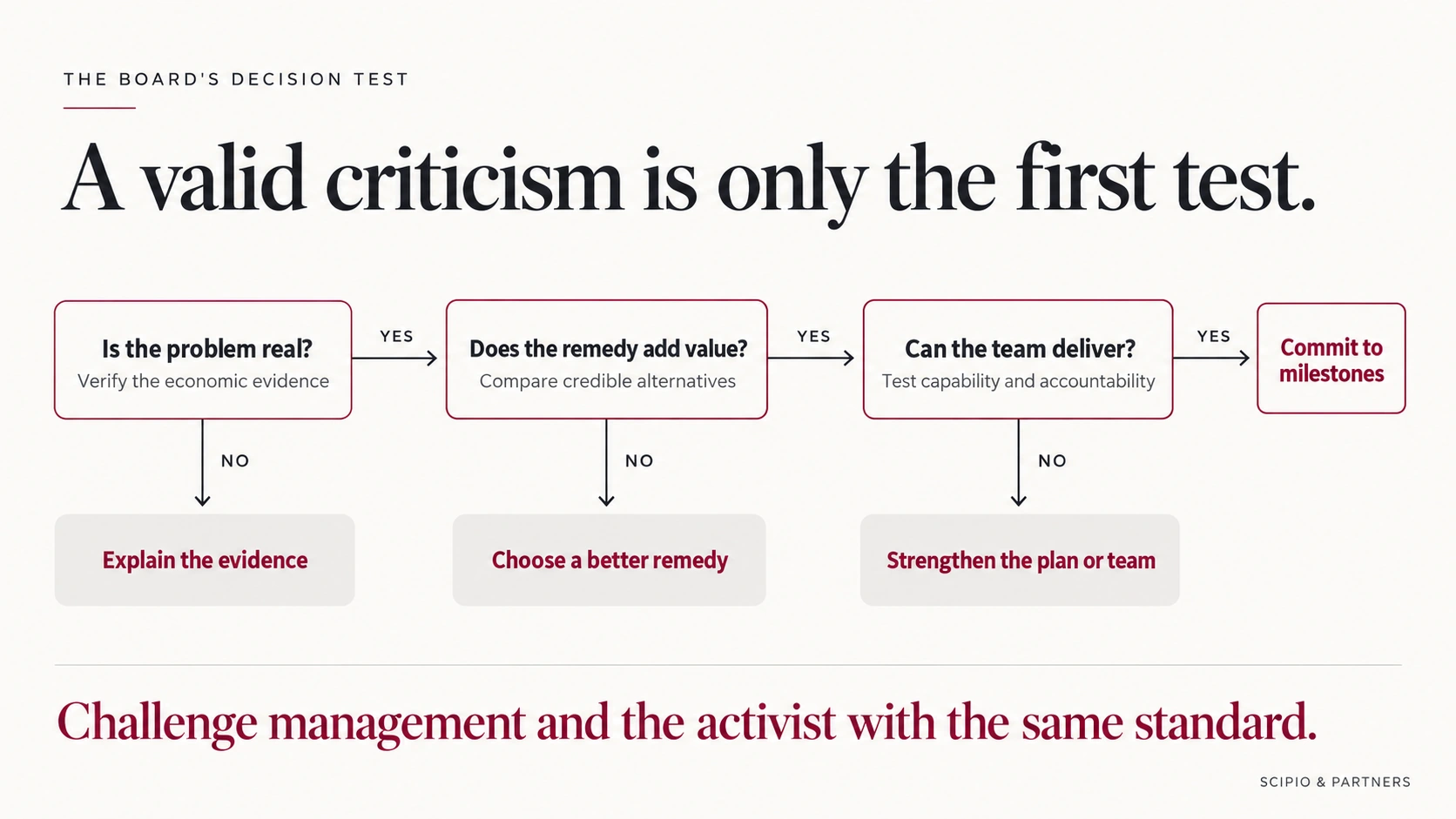
Give the problem, the proposed remedy and the delivery capability separate scrutiny.
Read the framework
- Is the problem real?
- Verify the economic evidence. If the claim is unsupported, explain the evidence. If supported, assess the remedy.
- Does the remedy add value?
- Compare credible alternatives. If the proposal fails this test, choose a better remedy for the underlying problem. If it passes, assess delivery capability.
- Can the team deliver?
- Test capability and accountability. If they are insufficient, strengthen the plan or team. If they are credible, commit to explicit milestones.
- One standard
- Apply all three tests to management's proposal and the activist's proposal. A failed test calls for a response to that gap; it does not erase a valid finding from an earlier test.
This changes the tone of engagement. The board can acknowledge an underperforming business, commit to an independent review and still reject an uneconomic break-up. It can support a strategic direction while changing the people or incentives responsible for delivery. Intellectual independence becomes visible through the decisions the board makes.
2. Make the performance case survive an unfriendly reading.
Total shareholder return is an outcome that deserves attention. It is also the beginning of a diagnostic, rather than a complete explanation. Reconcile the return with operating growth, margins, cash conversion, capital employed, distributions, financing and changes in valuation. Distinguish a sector-wide repricing from a company-specific delivery failure.
Use consistent measurement dates, dividend treatment, currencies and peer definitions. Show several relevant horizons, including the period before the latest strategic reset. A recent recovery can demonstrate progress while a longer history still raises legitimate questions about capital allocation. Neither observation needs to cancel the other.
At business-unit level, test whether reported improvement survives the removal of temporary benefits. Are margins improving because processes changed, or because investment was deferred? Did cash conversion improve through better operations, or a working-capital movement that will reverse? Does the return calculation include the capital consumed by acquisitions? The board needs a bridge from reported progress to repeatable economics.
Source documents: Alkermes investor presentation announcement, 8 June 2023; Sarissa presentation filed with the SEC, June 2023.
The practical output is a short evidence register: the claim, the supporting data, the counter-evidence, the unresolved assumption and the decision it could change. Assign an owner to every material uncertainty. This is more useful than commissioning a larger presentation whose conclusions were decided at the outset.
3. Price the separation, the turnaround and the sale on equal terms.
A sum-of-the-parts valuation can reveal a real problem: the current structure may obscure performance, misallocate capital or prevent businesses from operating at their best. It does not, by itself, establish that a break-up creates value. The attractive multiple belongs to a future standalone business that must be financed, governed and operated.
Build an explicit view of the separation perimeter. Which customers, intellectual property, distribution channels, systems, people and purchasing arrangements are shared? Which costs disappear, which remain with the parent and which must be duplicated? Include tax, pensions, debt allocation, transitional services, dis-synergies and the cost of maintaining continuity. Bring specialist financial, tax and legal advisers into the assumptions that require their judgement.
Challenge the integrated case just as hard. Shared ownership earns its place through advantages that can be evidenced: lower cost, better access to customers, transferable capabilities or superior capital allocation. A collection of management assertions about synergy is insufficient. If the corporate centre cannot demonstrate its contribution, the separation thesis becomes more compelling.
Exhibit 02
A break-up must earn its valuation uplift.
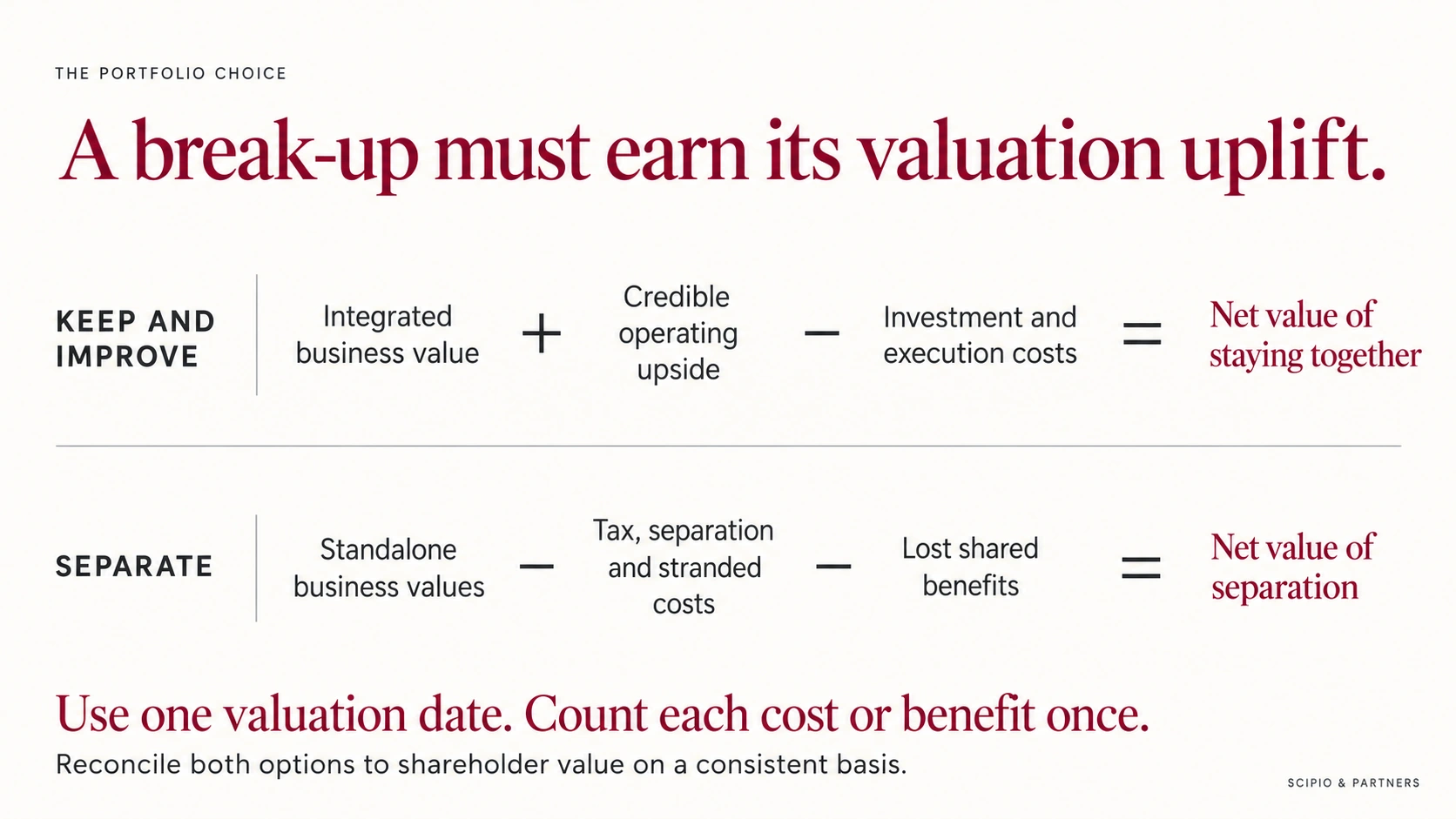
Compare the value shareholders can retain after the costs of making each option work.
Read the framework
- Keep and improve
- Start with integrated business value, add credible operating upside and subtract the investment and execution costs required to realise it. The result is the net value of staying together.
- Separate
- Start with standalone business values and subtract tax, separation and stranded costs, together with lost shared benefits. The result is the net value of separation.
- A comparable basis
- Use the same valuation date, realistic funding and explicit downside cases. These are decision reconciliations, not a numerical valuation model. If a cost or benefit is already embedded in a cash-flow valuation, do not count it again. Reconcile enterprise value to shareholder value consistently for debt, cash and other claims.
Compare a sale on the same basis. What proceeds would shareholders receive, when, and with what completion risk? What value remains available under a credible standalone plan? What funding and management attention does each route consume? The highest headline number may depend on the most fragile assumptions.
5. A defensive transaction still needs an investment case.
The pressure of a campaign can distort capital allocation. A buyback, special dividend, asset sale or new strategic investor may be economically attractive. It may also consume resources that the business needs or make a contested governance position harder to explain. Evaluate the commercial merits and the governance effects explicitly.
Ask a simple counterfactual: would we recommend this transaction, on these terms, if the campaign did not exist? If the answer changes, document why. Consider financing costs, dilution, liquidity, alternatives and the rights granted. A capital provider’s reputation cannot substitute for that work.
Source documents: Box statement filed with the SEC, 17 May 2021; Starboard books-and-records demand, 20 May 2021.
Use the same discipline when considering settlement. A board seat, committee role or agreed strategic review changes how decisions will be made. Assess whether the arrangement improves oversight and execution, how conflicts will be managed and what happens when the agreement expires. The value of a settlement lies in the quality of the resulting governance and business plan, as well as the cost and disruption it avoids.
6. Global capital does not mean interchangeable governance.
The economic questions travel well across borders: performance, capital allocation, portfolio logic and management accountability. The route through which an investor can force a decision does not. Incorporation, listing, ownership concentration, governing documents and local stakeholder arrangements all affect the choices available.
For US companies within the SEC universal-proxy regime, non-exempt solicitations in contested director elections use cards listing both sides’ nominees. Shareholders can select candidates across the competing slates. The strategic implication is to explain the contribution of each director, alongside the case for the board as a whole. Check the regime’s scope and the relevant company’s election rules before translating that principle into a campaign plan.
Source documents: SEC universal-proxy compliance guide.
A German Aktiengesellschaft has a different allocation of authority. The management board runs the company under its own responsibility; the supervisory board supervises management and cannot simply take over its management functions. The practical engagement map must reflect that distinction, alongside the shareholder structure and any applicable employee representation. A US-style director-election narrative is an incomplete operating model for this setting.
Source documents: German Stock Corporation Act, section 76; German Stock Corporation Act, section 111.
For a cross-border group, develop one economic case and a jurisdiction-specific route to decision. Map which board owns which decision, which shareholder or regulatory approvals matter, and where employment, financing or separation dependencies sit. Ask local counsel to validate the route early. A globally consistent message cannot compensate for an execution plan that ignores a local constraint.
Where an activist calls for a sale, or a bidder enters the situation, distinguish the strategic evaluation from the takeover process. Test the offer against alternatives while specialists manage disclosure, transaction rules, competition and investment-screening requirements where applicable. A proxy contest, a negotiated sale and a public takeover can intersect without becoming the same process.
7. Run the response on two clocks.
The campaign has deadlines: nominations, disclosures, meetings, votes and negotiations. The business has a different timetable: customer decisions, operating changes, investment and cash generation. Both require attention. A company that pauses execution to concentrate on the campaign may weaken the very case it needs to make.
Keep a small response team around one evidence base. The chair or appropriate independent director owns board engagement and oversight. Management owns the operating plan. Finance reconciles the economics. Strategy challenges the alternatives. Legal counsel controls the legal process and disclosure requirements, while investor relations and communications coordinate engagement. Specialists should resolve decisions, rather than create competing versions of the story.
Exhibit 03
The vote ends. The value commitment continues.
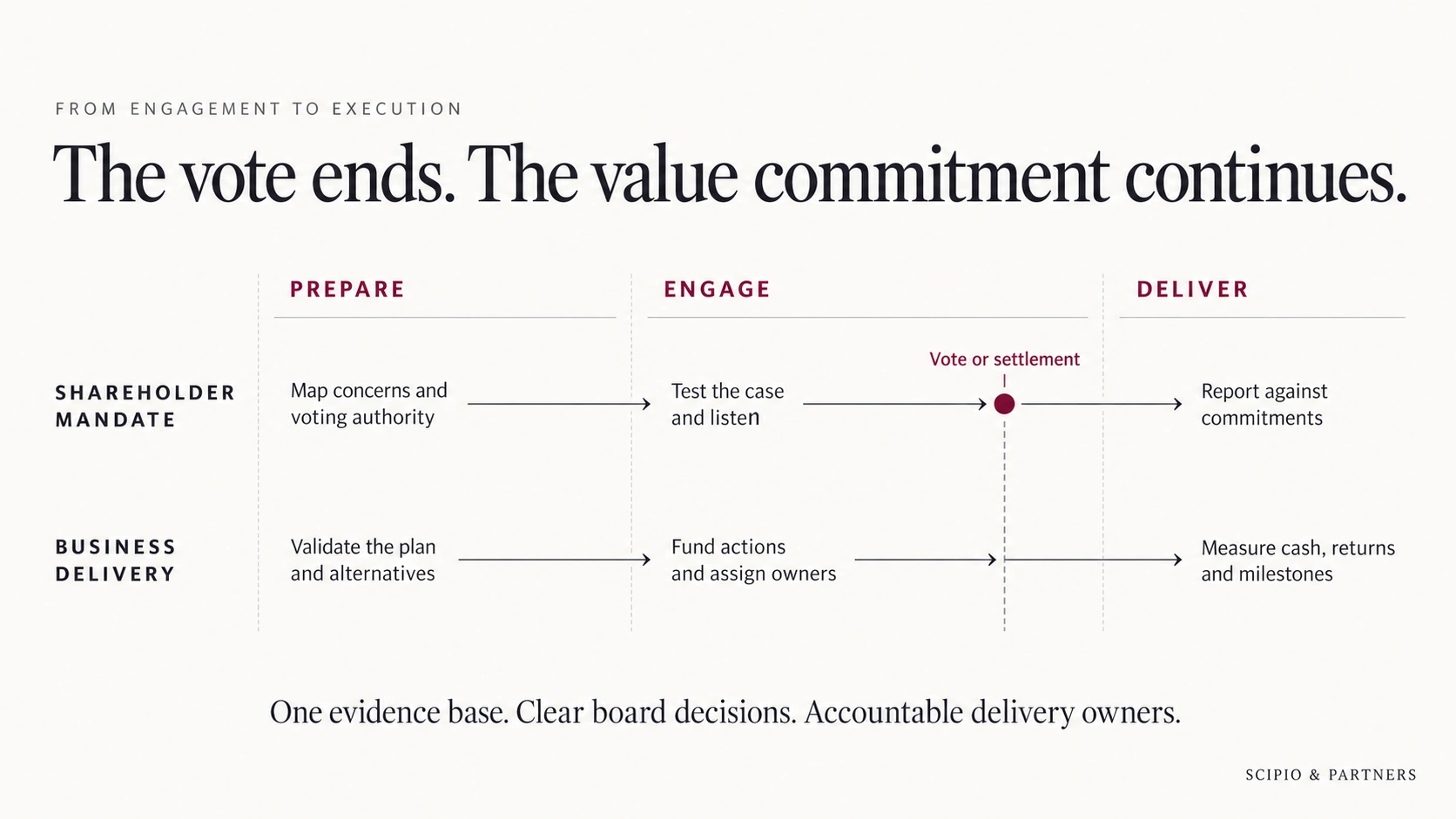
Manage the campaign timetable and the operating commitments as connected workstreams.
Read the framework
- Prepare
- For the shareholder mandate, map concerns and voting authority. For business delivery, validate the plan and its alternatives.
- Engage
- Test the case and listen to shareholders while funding the business actions and assigning accountable owners.
- Vote or settlement
- Treat the outcome as a governance checkpoint, not the end of business delivery. Carry the resulting commitments into execution.
- Deliver
- Report against commitments and measure cash, returns and operating milestones. Continue both shareholder engagement and business delivery.
- Shared accountability
- Use one evidence base, clear board decisions and accountable delivery owners. The diagram describes workstreams, not a universal legal timetable.
Set a compact dashboard around commitments that investors can eventually verify: operating milestones, return on invested capital, cash conversion, allocation of capital and the costs of delivery. Pair lagging financial measures with leading evidence, such as a completed separation design or adoption of a redesigned commercial process. Make the bridge to financial results explicit.
Define the decision that follows a missed milestone. Does investment stop? Does a business enter a sale review? Does accountability change? A plan with targets but no consequence for repeated failure asks shareholders to extend trust without a mechanism for protecting it.
After a vote or settlement, maintain the reporting discipline. Shareholder support buys an opportunity to execute. It does not retire the economic questions that produced the campaign.
8. Make the next board session an examination of choices.
Preparation should leave the board with decisions it is willing to own. We would organise the next session around a deliberately demanding set of questions.
Six questions worth answering before an activist asks them.
- Where is our strongest economic vulnerability, and which evidence would change our assessment?
- Which business earns its place in the portfolio—and which depends on an unproven claim about shared benefits?
- Have we compared investment, separation, capital return and sale alternatives on a consistent net-value basis?
- Which capabilities and decision rights does the preferred plan require, and where are the gaps?
- Which shareholders remain unconvinced, and what specifically are they asking us to demonstrate?
- What will we deliver next, who owns it, and what decision follows if we miss?
Scipio & Partners brings corporate strategy, portfolio and capital allocation, transaction assessment and transformation delivery into this discussion. The purpose is to establish a credible set of choices, substantiate the preferred route and connect board commitments to operating action, working alongside legal and financial advisers.
The strongest position is a board that has tested its own assumptions, changed what needed changing and can explain what happens next. Earn that mandate before someone else defines the choice.