Insight · Performance improvement
Zero-based budgeting: fund the work that matters.
Rebuild the cost base, change how work gets done and make the savings last.

At a glance.
Start with the work the business needs, then build the budget.
Give cost owners and business leaders a shared decision process.
Translate every approved change into delivery and financial results.
A budget can meet its savings target while leaving the organisation almost unchanged. Teams negotiate a lower number, postpone spending and keep the same activities, service expectations and approval chains. When demand returns, the costs return with it.
Zero-based budgeting offers a more demanding starting point: what work should the business fund, at what level of service, and through which operating model? The value comes from making those choices explicit. A detailed spreadsheet is useful only if it helps leaders decide what to stop, what to redesign and where to invest.
For a leadership team, the practical challenge is to connect that ambition to everyday decisions. The following approach treats ZBB as a way to allocate resources and change operations, with finance providing the discipline to turn those choices into a credible budget.
1. Decide what the business must protect.
Before challenging cost packages, agree which capabilities matter to the strategy. In a retailer, product availability, reliable fulfilment and the customer experience may deserve protection even as the organisation reduces complexity elsewhere. A uniform savings percentage across every function cannot express those choices.
Ask business leaders to describe the outcome each activity supports. Then distinguish an essential service from a legacy habit and a differentiating capability from an expensive version of a standard process. The same cost category can contain all three. Marketing, for example, includes work that builds demand and work that exists because the organisation has accumulated overlapping agencies, reports and approval layers.
This discussion should produce explicit guardrails: the customer outcomes, service levels and capabilities that a cost initiative must preserve. It should also identify potential reinvestment priorities. Funding them still requires a business case; calling an activity strategic should not exempt it from scrutiny.
Exhibit 01
From resource choices to results.
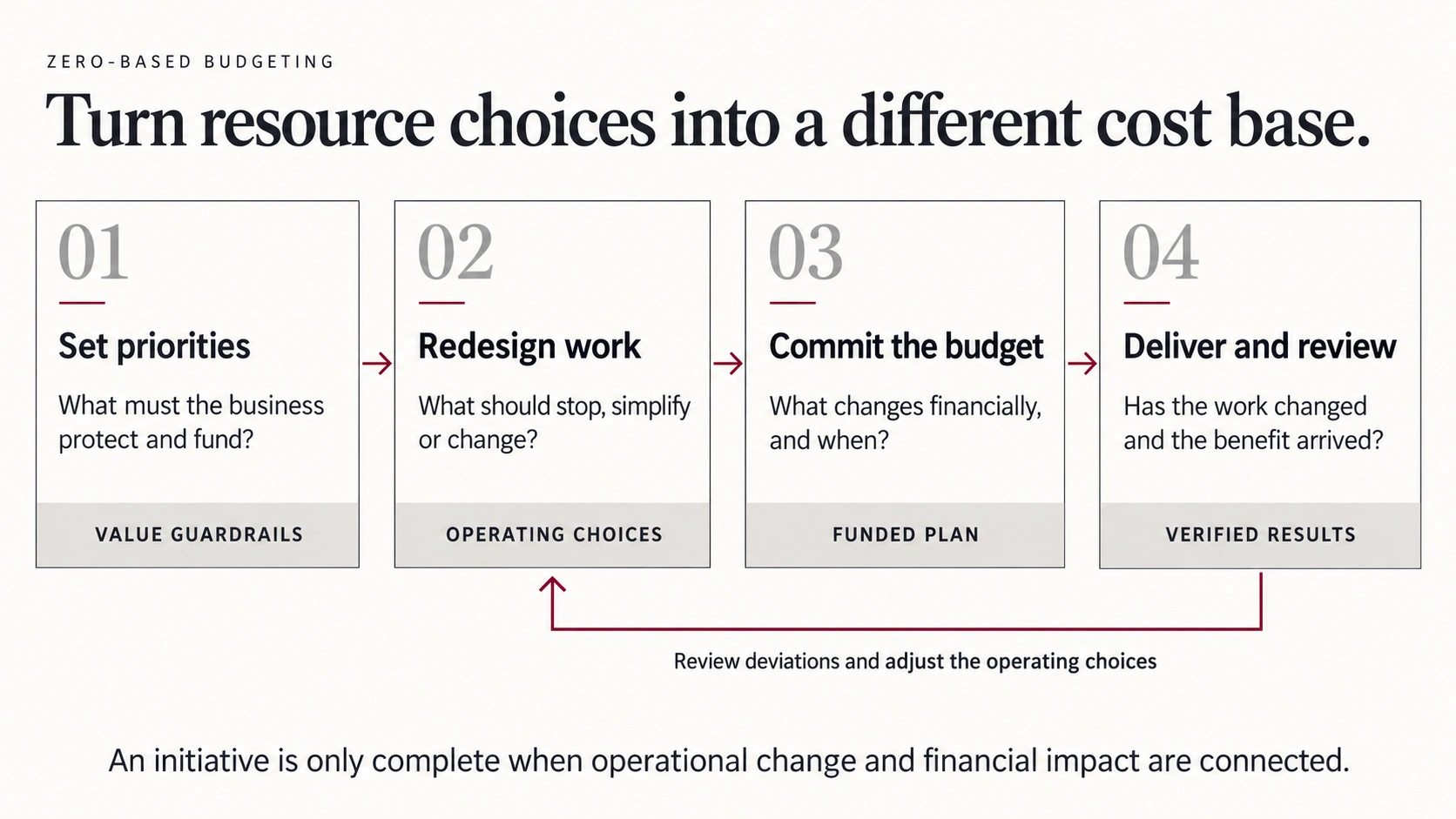
Four linked decisions connect strategic priorities to a measurable change in the cost base.
Read the framework
- 01 · Set priorities: value guardrails
- What must the business protect and fund? Define the outcomes and capabilities that cost choices must preserve.
- 02 · Redesign work: operating choices
- What should stop, simplify or change? Challenge activities and choose how the necessary work will be delivered.
- 03 · Commit the budget: funded plan
- What changes financially, and when? Connect the operating choices to budget lines, costs, benefits and timing.
- 04 · Deliver and review: verified results
- Has the work changed and the benefit arrived? Check operational delivery and financial impact together.
- Feedback from stage 04 to stage 02
- Review deviations and adjust the operating choices. An initiative is only complete when operational change and financial impact are connected.
2. Build a baseline people can challenge.
A ledger tells you where expenditure was booked. It rarely explains which business demand created it. Build cost packages that make an activity visible across functions and business units: technology, logistics, facilities or external services, for example. Reconcile those packages to finance, so the programme and the budget start from the same total.
For each package, separate volume, service level, unit cost and capacity. A delivery cost increase might reflect more orders, smaller baskets, additional express deliveries or a higher carrier rate. Each requires a different response. Negotiating the rate alone leaves the other drivers untouched.
Document the assumptions and the data gaps. Use benchmarks to identify questions worth investigating, then adjust for differences in customer proposition, scale and operating model. A peer comparison is a challenge to explain a gap, not sufficient evidence that the same cost level is achievable.
Four questions behind a cost package
Demand
What activity creates the need, and can unnecessary demand be removed?
Service
Which quality and speed does the customer or business actually require?
Delivery
Who should do the work, using which process, capacity and technology?
Economics
What drives unit cost, and when will a change affect the budget?
3. Challenge the activity behind the invoice.
The first opportunity list often follows the chart of accounts: travel, contractors, software and meeting costs. That is a useful entry point, but the larger decision may sit upstream. Travel can be a consequence of where roles are located. Contractor demand can reflect unclear internal ownership. Meeting costs can be a symptom of a decision process that requires too many people.
Develop alternatives at the level of work. Remove activities that no longer serve a clear purpose, simplify what remains, and then assess standardisation, automation, sourcing and commercial terms. Automating a redundant report preserves the wrong activity at a lower unit cost.
Compare alternatives against the agreed guardrails. Include transition effort, implementation cost, dependencies and the effect on customers and employees. A seemingly attractive option may simply transfer cost to another department or push unresolved work onto frontline teams.
Exhibit 02
Remove duplicate work before automating what remains.
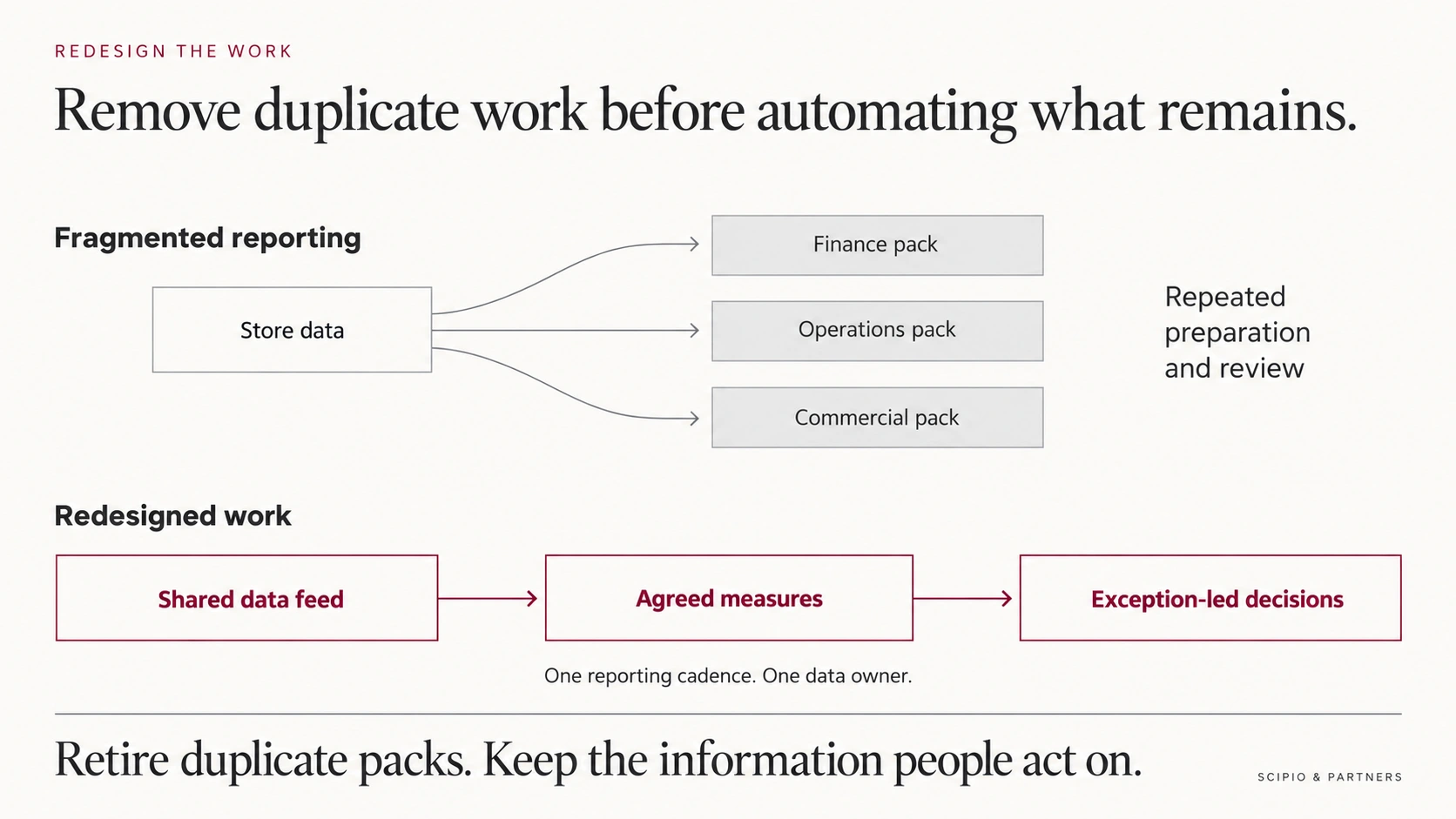
Rebuild the store-reporting workflow around the decisions it needs to support.
Read the framework
- Fragmented reporting
- The store-reporting example starts with the same store data feeding separate finance, operations and commercial packs. Parallel packs create repeated preparation and review.
- Redesigned work
- A shared data feed supplies agreed measures that support exception-led decisions. Keep one reporting cadence and one data owner.
- The operating choice
- Retire duplicate packs and keep the information people act on. The diagram compares two workflow designs; the business must still decide how released capacity will be used.
4. Make shared ownership a decision mechanism.
ZBB creates a useful tension between the leader responsible for a business result and the owner responsible for a cost package across the enterprise. The business leader understands demand and delivery. The package owner sees common standards, supplier economics and opportunities that disappear inside individual budgets.
The model needs clear decision rights. Specify who proposes a service level, who challenges its economics, who approves exceptions and who resolves a disagreement. Without that clarity, dual ownership becomes a second layer of meetings and neither person feels accountable for the result.
Finance should maintain the common baseline and validate the financial effect, while the operating owner remains responsible for changing the work. Agree a regular review of material deviations and their causes. A review that only reports red or green status does not make a trade-off or remove a delivery obstacle.
Exhibit 03
Make the ownership model explicit.
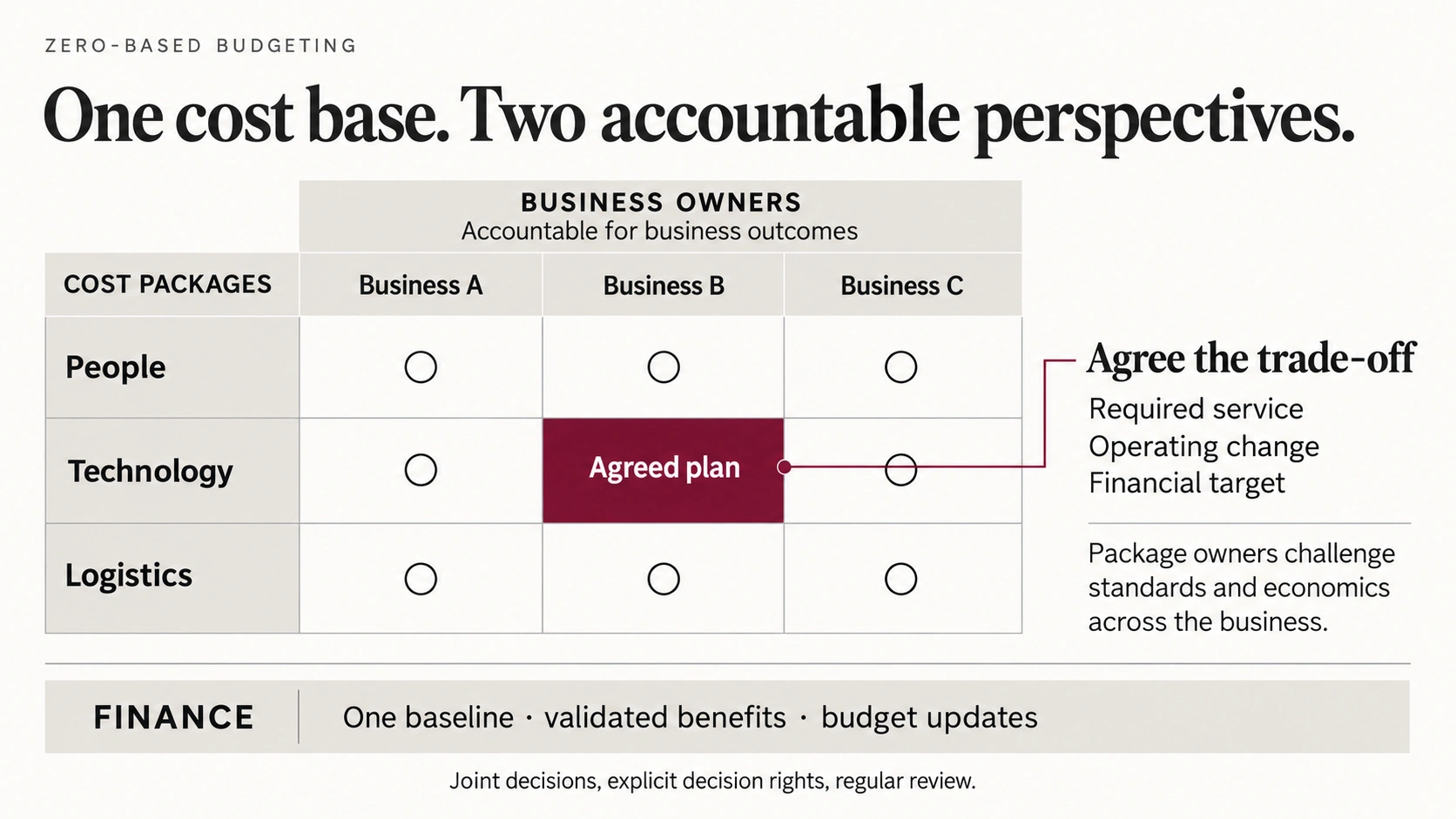
Business and package owners agree the plan; finance validates its effect on the budget.
Read the framework
- Vertical perspective · business owners
- The three illustrative columns represent Businesses A, B and C. Each business owner is accountable for business outcomes across its cost packages.
- Horizontal perspective · cost-package owners
- The rows represent People, Technology and Logistics. Each package owner challenges standards and economics across all three businesses.
- At the intersection · one agreed plan
- Every circle marks a shared cost decision. The highlighted Technology × Business B cell illustrates agreement on the required service, operating change and financial target. It does not represent a client result or a performance score.
- The foundation · finance
- Finance maintains one baseline, validates benefits and updates the budget. Joint decisions need explicit decision rights and a regular review of deviations.
5. Follow the change all the way into the budget.
An approved initiative is not yet a financial result. Connect it to an owner, a delivery milestone, a budget line and a date when the benefit can start. Contract notice periods, recruitment plans, system changes and operational dependencies can all create a gap between the decision and the result.
Keep different types of benefit separate. Lower supplier expenditure is different from avoided future hiring, and both differ from capacity released for other work. Show gross recurring savings, implementation costs and approved reinvestment separately, with a consistent view of the net effect. This prevents the same benefit being claimed by procurement, a function and a transformation programme.
Exhibit 04
Released time is not automatically a cash saving.
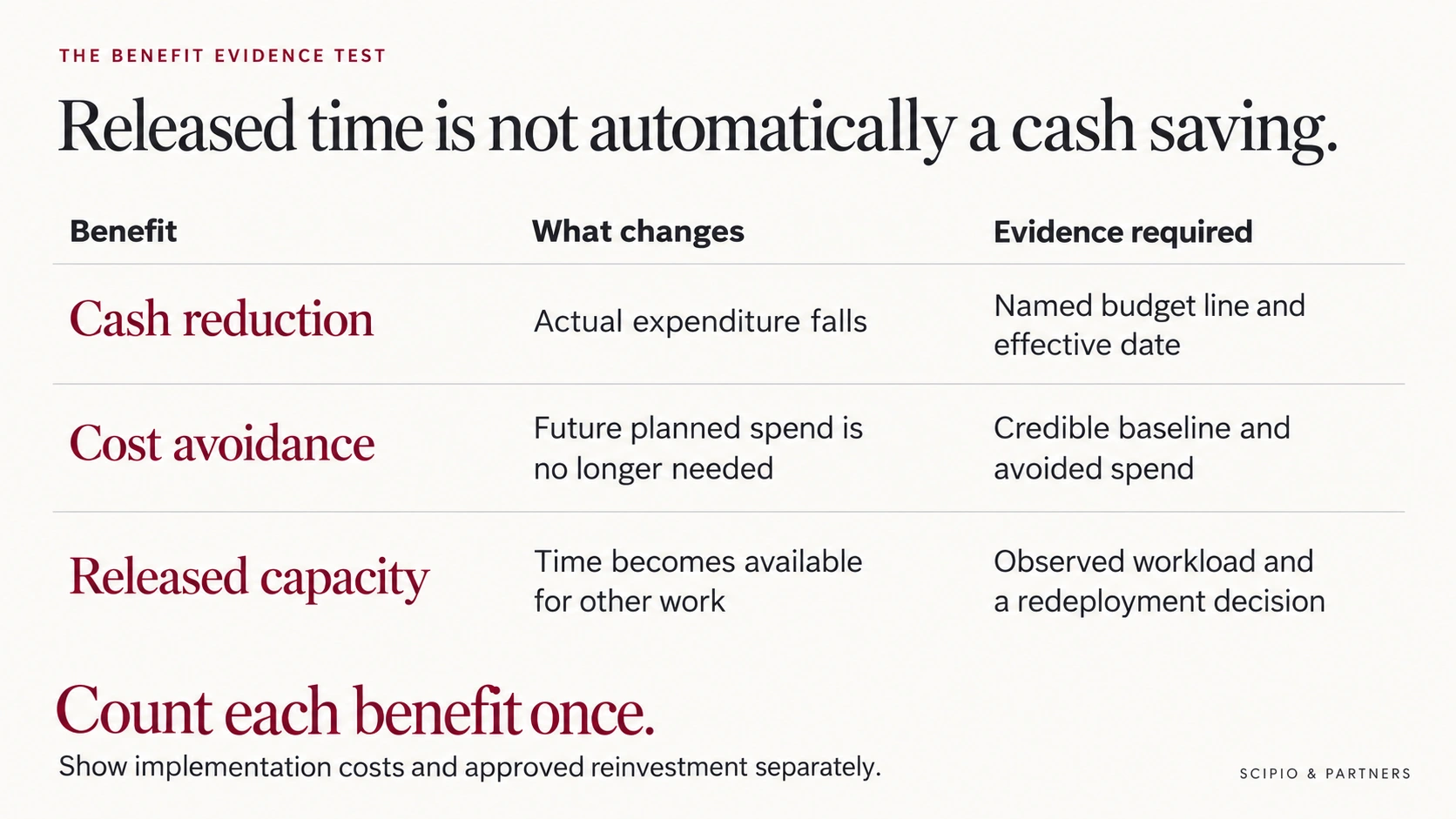
Connect each benefit to the evidence that supports it and the decision needed to realise it.
Read the framework
- Cash reduction
- Actual expenditure falls. Identify the budget line and effective date, and verify the reduction against the baseline.
- Cost avoidance
- Future planned spend is no longer needed. Establish a credible baseline and evidence of the expenditure avoided; do not describe it as a reduction in current spend.
- Released capacity
- Time becomes available for other work. Measure the workload change and agree how capacity will be redeployed. Released time is not automatically a cash saving.
- One benefit, one claim
- Count each benefit once. Show implementation costs and approved reinvestment separately, then reconcile the net effect to the budget.
Then change the mechanisms that could recreate the old cost base. Update approval thresholds, purchasing rules, service agreements, role responsibilities and planning assumptions. Teams need to understand the choices and the reasons behind them. A lower budget without a workable operating model encourages deferral, exceptions or a quiet return to the previous way of working.
6. Leave the first review with decisions.
Start with a manageable set of cost packages that combine material spend, a credible operational question and an owner able to act. Use the first cycle to prove the connection between the baseline, the operating choice and the budget. Expanding a weak process across the whole company only increases the reporting burden.
The leadership discussion should end with a short decision record. Where evidence is missing, assign the question and a return date. Where a trade-off is accepted, record the service implication as well as the financial target. Where investment is needed, make the dependency explicit before committing to the benefit.
Questions to take into the room
- Which customer outcomes and capabilities must this programme protect?
- Can we reconcile the cost package to the budget and explain its main drivers?
- Which activities will stop or change, and who owns those decisions?
- What service, people or implementation risks need to be resolved?
- Is the benefit a cash reduction, cost avoidance or capacity release?
- What will change in the budget, by when, and what prevents the cost returning?
A useful ZBB programme leaves behind more than a smaller spending plan. It establishes a repeatable way to question demand, make resource choices and hold the organisation to them. The enduring result is the ability to fund priorities deliberately, rather than inherit them from last year’s budget.